My Blog List

Monday, April 5, 2010

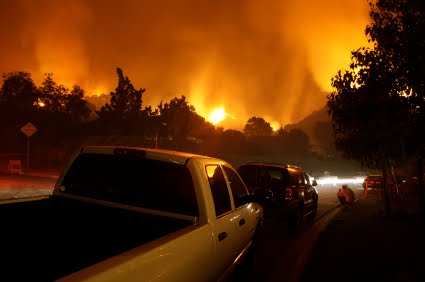
Preps: Evacuation Plan

We're now half way through posting about the 12 Impacts you should plan for in your preps.  As we've stated before, in our view, Emergency Preparedness needs to focus more on limiting negative impacts to disasters than on preparing for specific events (earthquake, hurricane, etc.).  We discussed that philosophy and those Twelve Impacts in an earlier post.  You can see all of the items in the series to this point by clicking the 12 Impacts label category.

At this mid-point, we're going to take another detour, but a very closely related one.  With any kind of sudden emergency, you will have two immediate actions:  Evacuate or Shelter In Place.  These are handled by the use of very simple checklists - one for each location you might find yourself during an emergency:  Home, Work or One The Road.

Today, we'll cover developing an Evacuation Plan.
---

In February, we did a post on Shelter-In-Place (SIP).  This post will explore what you should do if government officials order an evacuation, or if you decide to "bug-out" based upon your own analysis of the situation.

Because the thought process and equipment needed for an evacuation are much more extensive and critical than it is for a SIP plan - you're leaving the majority of your "stuff" behind - we'll be breaking this into two posts. [UPDATED - to three posts]

Today, we'll cover the Bug-Out-Bag (BOB) Contents and your Evacuation Checklist.  Tomorrow, we'll cover Evacuation Transportation and Determining/Mapping Evacuation Destinations. [UPDATED - third post on Voluntary Activation of you Evacuation Plan]
--

As with SIP, your plan is based upon a simple, easy to use checklist.  It directs your actions during a time of high stress.  This checklist will ensure that the actions you need to take and the gear you need to grab are not overlooked.

Also, as with your SIP plan, you will want a kit that is a pre-packed repository of your food and other necessities.  The common term for this kit is a Bug Out Bag, or BOB.  It should contain, in order of importance, items to provide for your (1) Survival, (2) Post-Emergency Recovery and (3) Comfort.

BOB Contents

There is an almost religious fervor as to what should be included!  No one can tell you how much of which items you need to stock to prepare for your survival.  You have to determine that for yourself.  You also need to consider how you will transport your food and gear in the event you end up on foot.

Here is a post by my fellow California Preppers Network contributor, William Lankes, on what can be included.  Here's a very good post from the guys over at Survival Cache on the seven types of gear that should be in your BOB.  You can get a very detailed list here (PDF) from the folks at Survivalist Site.

Do a Google search for "BOB contents" if you need more ideas.

You must assume your BOB will contain all of your worldly goods.  I like to assume that my house has burned to the ground, everything was lost, and I have nothing other than what is in my BOB.

As I've discussed in the past, when the Oakland Hills Firestorm hit in 1991, that is EXACTLY what happened to my grandfather.  The only thing left in the area were the fire bricks from his neighbor's chimney.

As with most preparedness things, your BOB design and content is VERY personalized.  Some people fill one or more backpacks.  Personally, our BOB consists of multiple 60-quart lidded tubs you get at Walmart (Rubbermade, etc.).  They are individually numbered.  We grab them in order, based upon how much time and the number of vehicles we have at home when we evacuate.

Box One provides us with food, water purification, various types of equipment and self-defense items for 4 people for 11 days.  It also contains copies of our critical records, medical/first aid items and $1,000 in cash.

The food in Box One is in the form of Survival Bars and MREs.  Successive boxes contain more "normal" foods, such as canned meats, dried beans, grains, rice and pasta, spices and oils, etc.  Earlier boxes are filled with more densely-packed foods (high calorie, high protein), and later boxes contain more "comfort" items such as deserts, sweets, gravies and the like.

Equipment and tools to prepare the foods are added to the boxes as is appropriate.  Also, the first 4 boxes each contain a rudimentary ruck sack so that the contents can be carried in the event we are forced to abandon our vehicle(s). [We originally used the ruck sacks as the BOBs, but found it much easier to identify, catalog and rotate the contents when they are in a tub].

Remember:  When you're developing your own BOB, build it so that Survival, Post-Emergency Recovery, then Comfort are address, in that order.


BOB Contents
  1. Water filtration/purification
  2. Food for a minimum 1500 calories (more is better) per day, per person
  3. Self-defense weapons (at a very minimum, you should have a number of dedicated pepper spray canisters in your BOB - these are legal in all 50 states)
  4. Cash (this gives you options should events not unfold as you have planned)
  5. Shelter (tarps, ponchos, rope/paracord, tents, etc.).  This also includes clothing appropriate to the region and season.
  6. Fire-making tools (disposable lighters AND matches AND fire steels AND tinder)
  7. Important Records
  8. Sanitation items
  9. Medical/first aid items
  10. Air filtration masks
  11. Portable radio (preferably a dynamo-powered model)
  12. Travel Alternatives (you may be forced to abandon your vehicle)
You'll also notice that a number of items may require you to develop some new skills.  Do you know how to build a fire?  Erect a tent?  Build a tarp shelter?  Render first aid?  Set a broken bone?  Purify water?

Obviously, you and your entire group should learn and practice these skills now, before they're needed during a stressful emergency situation.


Evacuation Checklist

This list assumes you have some sort of vehicle with which to evacuate.  You should also assume you'll be forced to evacuate on foot, or be forced to abandon your vehicle before you reach your final destination.

Follow the checklist, IN ORDER of what you have deemed most important.  If you can complete all of the items, that is great.  But you may not have the time to do so.  Your list is prioritized to first provide you with Survival, THEN Post-Emergency Recovery, THEN Comfort.

YOUR OWN LIST MUST BE CUSTOMIZED FOR YOUR LIFESTYLE.

Evacuation Checklist (in order of completion)
  1. Load BOB into vehicle.
  2. Load emergency supplies of gasoline into vehicle. 
  3. Load Sleeping bags into vehicle.
  4. Determine evacuation destination and choose primary route
  5. Contact evacuation destination and inform them of the primary route being taken
  6. Post evacuation destination, primary route and destination contact information inside your home
  7. Load additional supplies (other than those in your BOB) as time and space allows
    1. Precious metals/additional cash
    2. Additional clothing
    3. Additional weapons
    4. Home business records, family photographs, computers, storage drives
Tomorrow:  Evacuation Transportation and Determining/Mapping Evacuation Destinations

Accept The Challenge

At some time in your life, it is very likely you'll need to evacuate your home.  It could be the result of a natural disaster, an accident or terrorist incident, or a horrible event, such as a house fire.

One of the key considerations is to have a mini-plan for evacuating from your work or while you're away from home.  Having a Get Home Bag (GHB) - which is really a smaller version of a BOB - can make your life much easier.  The biggest difference is that its focus is strictly on Survival - you're not concentrating on Post-Emergency Recovery or Comfort.

And, as with the SIP Checklist, if your place of employment does not have an Evacuation Plan, make one for yourself.  Don't become a victim simply because your company lacks foresight.

---
Please click our advertiser links. They pay us so you don't have to. A click a day is all we ask!

Copyright 2010 Bison Risk Management Associates. All rights reserved. You are encouraged to repost this information so long as it is credited to Bison Risk Management Associates. www.BisonRMA.com

Sunday, April 4, 2010

How High?

This stinks on so many levels -
U.S. Treasury Secretary Timothy Geithner said on Saturday he was delaying an April 15 report on whether China manipulates its currency but pledged to press for a more flexible Chinese currency policy.
Translation: Cower in the corner so you don't piss off your lender. Make sure you release the news of your cowardice on the weekend, when your compliant Media Scribes aren't at work.

China, shockingly, is acting in its own best interest. They have policies and programs that are in place for the well-being of their citizens. By keeping their exchange rate at a level which is beneficial to China, they are able to sell more of their products to the rest of the world.

Their policies make their exports less expensive for the rest of the world to buy, and imports more expensive for the Chinese to buy.  The result of the high import costs means that the Chinese have an incentive to produce more of their own goods - employing even more Chinese citizens.

What a concept: A government acting in its citizen's best interests.

Not wanting to just genuflect to our lenders, Timmy wants to whine about it as well -
Geithner implied that China's current policy was unfair to others, citing Germany and Japan's efforts to spur their domestic demand while maintaining floating exchange rates.

"Surplus economies with inflexible exchange rates should contribute to high and sustained global growth and rebalancing by combining policy efforts to strengthen domestic demand with greater exchange rate flexibility," he said.

"This is especially true in China," he added, noting that China managed to come through the financial crisis that wreaked havoc on other countries' economies while maintaining a 9 percent rate of economic growth in 2009.
Translation:  Everyone else is ruining their currency - you should, too!  Why should your, "surplus economy" be able to grow when all of ours are contracting?!

Geithner should institute policies that punish China for manipulating their currency, and impose sanctions that would be beneficial to the US.  Congress should rise up with One Voice and pass laws that would teach China to never mess with us again [I actually chuckled out loud when I wrote that].

But of course, they won't.  They know that China has us by the throat (or somewhere lower).  We've practically asked them to do so. 

Our policies of spending much, much more than we "bring in" have placed us at the mercy of countries like China.  The threat of them cutting off our credit line is causing us to take actions which are not in the country's best interest.

When China says, "Jump," our only reply can be, "How high?"

To save face, I'm guessing we'll issue some watered-down proclamation that is accompanied by a vigorous finger-shaking to the East.  We'll impose a few sanctions on some fringe products.  The administration will set up photo-ops with a small business owner in Toad Suck, Ark., who will share glowing reports of how his state-of-the-art dehydrated water business ("Just add water, and you've got.... water") plant was saved from the ravages of the Chinese.

And then little else will change.  You don't bite the hand that keeps you fed.


---
Please click our advertiser links. They pay us so you don't have to. A click a day is all we ask!

Copyright 2010 Bison Risk Management Associates. All rights reserved. You are encouraged to repost this information so long as it is credited to Bison Risk Management Associates. www.BisonRMA.com

Saturday, April 3, 2010

Outside of the Comfort Zone

I'm quite excited.

The owners of the gun range where I do the bulk of my teaching - Center Mass Shooting Range in Vacaville, CA (gotta love that name!) - had mentioned that they had been getting a number of inquiries from customers about learning how to use their guns in a practical way.  Primarily for home defense, but also for concealed carry and any other defensive situations.

We scratched out some ideas together, and I developed an outline.  I used my IDPA experience as the primary reference.  It is focused on practical skills, not on the speed and flash of IPSC (no offense to IPSC shooters!).

Defensive skills using regular, off-the-shelf handguns.

Yesterday, I did  a dry run with 3 students.  It went very well.  The experience level was from rookie shooters to years of experience.  They ALL loved the class!

It will take most folks out of their comfort zone - but that's the idea.  Learning how to perform under a variety of different scenarios that you just can't replicate or practice in a normal shooting range setting.

We'll be offering the class to the public in May, and will likely do a discounted "early bird" class for past students of my other classes before that.  We're still working out all of the details.  I'll post more information as we get closer to "game time".

Accept The Challenge

Developing new skills is so important for all of us.  The skill category is almost irrelevant.  Whether it is developing new shooting skills, or experimenting with ways to make water potable, we need to push ourselves into being able to function in circumstances that are not optimal. 

We need to be able to adapt.  We do that by developing a broad set of skills.  Some may work in one situation, others may not.  The whole, "arrows in the quiver" thing.

Sticking with the shooting meme, if an armed intruder is in your home, it will be unlikely that they will remain stationary - allowing you to line up your sights and carefully adjust your grip and stance.  You and they will be moving, and they will likely be shooting AT YOU!

You need to have a broad set of skills to address the situation.  Off-hand shooting, shooting from behind cover, moving and shooting, and reloading, to name just a few.

Push yourself.  Get uncomfortable.

---
Please click our advertiser links. They pay us so you don't have to. A click a day is all we ask!

Copyright 2010 Bison Risk Management Associates. All rights reserved. You are encouraged to repost this information so long as it is credited to Bison Risk Management Associates. www.BisonRMA.com

Thursday, April 1, 2010

Applicable Individual = Cash Cow

The more I read about the health care bill, the more incensed I become.  How is it possible that something like this can be happening in America?

I pray that this is an April Fools joke.

Sadly, it ISN'T.  Most of us are now considered an, "Applicable Individual" by the new health care bill.  It is everyone that is required to spend their own money, or that of their employer, to purchase health care insurance, even if they don't want it.

There are always exceptions, so who gets off the hook (PDF)?  From Chapter 8 (Maintenance of Minimum Essential Coverage), Section 5000A -
(2) RELIGIOUS EXEMPTIONS.—
‘‘(A) RELIGIOUS CONSCIENCE EXEMPTION.—Such term [applicable individual - .ed]
shall not include any individual for any month if such individual has in effect an exemption under section 1311(d)(4)(H) of the Patient Protection and Affordable Care Act which certifies that such individual is a member of a recognized religious sect or division thereof described in section 1402(g)(1) and an adherent of established tenets or teachings of such sect or division as described in such section.

(...)

‘‘(3) INDIVIDUALS NOT LAWFULLY PRESENT.—Such term shall not include an individual for any month if for the month the individual is not a citizen or national of the United States or an alien lawfully present in the United States.
So, if you're a Muslim (they don't believe in insurance), Amish, American Indian or Christian Scientist, you're exempt from paying, but still get the benefits.

Not Lawfully Present?  Sounds like someone who has broken into your house.  To you and me, that means  Illegal Aliens.  If you are a citizen or legal alien, you must pay.

Yeah, follow the rules and pay.

Not only must we pay, but if we decide not to do so, we will have the new 16,500 IRS agents crawling up our butts, seizing our money and property, and generally making our lives miserable.

Are the Senators, Congressmen, Administration hacks and their compliant media scribes REALLY surprised people are rebelling against this kind of treatment?  Really!?
---

Speaking of Compliant Media Scribes, they're doing their best to put a positive spin on the latest unemployment report.  The headline -
U.S. jobless claims fall 6,000 last week
Sounds pretty good, right?  Well.... not so much.  There were still 439,000 NEW CLAIMS LAST WEEK!  In the article, they also make the point that last month, 190,000 new jobs were created last month.

I know I shouldn't even try to understand, but how can you have 439,000 new claims last week (averaging 447,000 per week for the month of March - or 1.8 million for the whole month), but at the same time they say there were 190,000 new jobs created.  How do you reconcile those two seemingly contradictory numbers?

We'll, I'm not even going to try, since the vast majority of the created jobs were for temporary US Census workers.
---

Treasury Secretary Geithner is telling us that high unemployment is here to stay for a while, so federal expenses are going to keep going up, but exemptions to paying for our federal largess are everywhere.  It is incredible to me that 36% of all people who filed a tax return had ZERO tax liability -
As a result, recently released IRS data for the 2008 tax year show that a record 51.6 million filers had no income tax obligation (see chart, click to enlarge). That means more than 36% of all Americans who filed a tax return for 2008 were nonpayers, raising serious doubts about the ability of the income tax system to continue funding the federal government's ballooning expenditures.
No tax liability.  What's that like?  Look at the chart they mention -


One way or the other, we're going to pay for this.  My guess is it will be a VAT -
In either scenario, the tax hike to come – as has been reported by many media outlets – is likely to be the “value added tax,” or VAT. The VAT is the most politically palatable means of raising revenue for a couple of reasons. It’s a stealth tax, for one. Consumers won’t see a line item on their receipts labeled “VAT,” but the costs will be built into the products they buy as surely as if it were a sales tax. It also appears to be a fair tax, since it applies equally to all goods and services. That’s how the VAT will be sold to the public, but the reality is quite a bit different.

The VAT is a regressive tax, making the costs of goods and services more expensive as a proportion of income for those who can least afford it. It’s also another way for government to extend the clinging claws of the bureaucracy even further into the free market, since the VAT is applied to every transaction that occurs along the way as goods are produced and services are offered. Liberals may – probably will – point out that some conservatives have championed VAT proposals in the past. True enough, but those conservatives who like the VAT do so as an alternative to an income tax, not in addition to an income tax.
Personally, I would love a VAT, but ONLY as an alternative to ALL other taxes.  But that will never happen.  It will be an addition to the taxes we now pay.

Accept The Challenge

The assault on our pocketbooks is never ending.  If you're not actively seeking ways to limit your tax exposure, you're going to be hit hard in the coming years.

Learn about and start employing barter.  Stop impulse buying, and plan your purchases.  In my latest post over at The California Preppers Network, I discussed purchasing your handguns via private party sales.  Here in my California county, that means you can reduce your out-of-pocket expenses for a $600 gun by almost $60.  That'll put a good deal of gas in the tank or preps in the pantry.  "A free 45 pound bucket of wheat with every handgun purchase!"

When you add in taxes on gasoline, sodas, alcohol, cigarettes and anything else our politicians can think of, you're not going to have any money left to do what you want.

Get educated on the "underground economy" and other similar concepts while you're still able.  It's going to require you to have skills or products that others need.  Look back into past difficult times - here in America and in places like the former Soviet Union - and see what people were willing to pay good money for.

Many, if not most, were restricted or outright illegal.  Time to pick your poison.

---
Please click our advertiser links. They pay us so you don't have to. A click a day is all we ask!

Copyright 2010 Bison Risk Management Associates. All rights reserved. You are encouraged to repost this information so long as it is credited to Bison Risk Management Associates. www.BisonRMA.com

Tuesday, March 30, 2010

Operations Security

Note:  I'm going to be mentioning the militia group in Michigan that was recently arrested by the FBI.  I'm not going to discuss the pros or cons of their group beliefs.  This is a preparedness blog, not a political blog.
--

The news is loaded with stories about the 9-member militia group primarily based in Michigan.  It is alleged they were planning the murder of a police officer, and the subsequent murders of the police officers that would have attended the funeral.

How did the FBI learn they were planning these murders?  Somewhere along the line, there was a break-down in the Operations Security (OpSec) of the group.

What's OpSec?
Operations security (OPSEC) is a process that identifies critical information to determine if friendly actions can be observed by adversary intelligence systems, determines if information obtained by adversaries could be interpreted to be useful to them, and then executes selected measures that eliminate or reduce adversary exploitation of friendly critical information.
As they used to say in World War II, "Loose Lips Sink Ships."  The message being, if you discussed where your ship was sailing, the enemy might be able to use that information to destroy your ship.

OpSec isn't a concept that should be limited to the military/militia.

Think about your preparedness plans and resources.  Why are you prepping?  You're doing it because you believe that there is a reasonable expectation that something bad will happen in the near future.  It might be some sort of natural or man-made disaster.  It might be as mild as a slowly growing rate of inflation, to as severe as a full-blown economic and societal collapse.

Let's say you have stored away 2 years worth of food and water.  You have dozens of guns and tens of thousands of rounds of ammo.  You have stored fuel, PV cells and generators.  Communications, medical supplies, gold, silver and miscellaneous equipment.

In short, you are fully self-sufficient if things go badly.

Let's say you have also told everyone that will listen to your perceived "survivalist rants" exactly how much stuff you have stored, and how clever you've been in also supplying a second "Bug Out" property at your family hunting cabin in the mountains.

If one of the worse-case scenarios happens, who do you think is going to be the target of a great number of non-preppers that are starving because the stores have no more food?  Sure, you might be able to repel the first few interlopers that attempt to raid your storage, but when hundreds of very motivated people are swarming you, you WILL eventually succumb to their attempts.

Even in "normal" times, knowledge of you having supplies of guns, ammo, precious metals and other valuable equipment can make you a target.  A casual comment from a friend that, "Bob is a BIG gun nut with all kinds of gold and silver," can result in a visit from intruders intent on "liberating" your very valuable items.

It will be interesting to hear how the FBI learned of the plans of the group in Michigan.  These were primarily family members and very good friends.  Supposedly, these guys had posted YouTube videos of some of their training, so they may have shined a spotlight on themselves.  Apparently, they never became acquainted with the phrase, "Stay off the ridge-line."

Regardless of the source, these people had a break-down in their OpSec.  They will most likely pay very dearly for that oversight.

Accept The Challenge

Generally speaking, you gain no benefit by disclosing your supplies, methods or plans to other people.  Preppers are generally a small segment of society, so in an attempt to explain to people why they should be prepping, we may give away information that makes us vulnerable.

By all means, discuss prepping with others who might want to become self-sufficient, but never disclose the amount of food and equipment you store, nor where you store them.  With regards to guns, ammo and precious metals, only your most trusted family and closest associates should know that you even store these items.

People like to get "pats on the back" when they have worked hard on a project.  It's human nature.  After putting a great deal of time, effort and expense into prepping, we might want to get some recognition for our hard work.

If you feel the need for this kind of adulation, go volunteer at a homeless shelter, and tell everyone about THAT!  Don't disclose the specifics of your plans.  Period.
---
Please click our advertiser links. They pay us so you don't have to. A click a day is all we ask!

Copyright 2010 Bison Risk Management Associates. All rights reserved. You are encouraged to repost this information so long as it is credited to Bison Risk Management Associates. www.BisonRMA.com

Monday, March 29, 2010

Tripwires

trip·wire  (trpwr)


1. A wire stretched near ground level to trip or ensnare an enemy.
2. A wire or line that activates a weapon, trap, or camera, for example, when pulled.
3. A small military force whose involvement in hostilities will trigger the use of a larger force.
In most prepper circles, the word tripwire is used to indicate an event which has occurred, which then results in some sort of response by the prepper.   A very simple example would be you losing your job (the event) results in you cutting back on your expenses (the response).

If you're really "on your game," you establish tripwires well enough in advance of an event having a negative impact on your life.  Using the example above, you might have set a tripwire whereby you watch your company's financial health.  If they were to post losses two quarters in a row, you might start looking for another job in anticipation of being laid off in the future.


The data sources being used are all-important.  The acronym GIGO - Garbage In, Garbage Out - says it all.  If your information is bad, your decisions will be bad.

Your interpretation of that data is key as well.  If you mis-interpret the information, your actions may be for naught.  The more time you put into interpreting the data, the more likely you are to come up with positive results.  Again using the earlier example, your company might be posting losses because they are making significant investments in equipment and personnel as they prepare for a major expansion.

So, what do you set up tripwires to watch?  Whatever you're concerned with. 

For some people, it might be personal financial.  For others, it might be broad economic trends.  Gun laws, government expansion, food prices, crop failures, international tensions - the topics are limitless.

What you want to do is identify events which might affect your various goals.

Let's say you want to store 1 year's worth of dried food away - corn, wheat, oats, beans and rice.  You don't know if you should buy it all now in one big purchase, of if you should buy it slowly over the next year.

On what kinds of things should you gather data?

Price/Availability:  What is the current price per pound of each item?  Are they likely to rise, stay flat or drop in the next year?  Let's say your research (crop yield forecasts and expected demand forecasts) indicate prices will remain flat, so there is no rush to buy right now.  You could set up a tripwire that if the futures price of any of these commodities increases by more than 5%, you will immediately buy all of your planned volumes of that commodity.

International:  What other countries currently consume large volumes of any of the items you want to purchase?  You could set up a tripwire for any crop failures or natural disasters which might wipe out any of these country's production.

Government policy:  Could any level of government enact legislation that would affect your ability to purchase your products?  Most of us remember the unintended consequence from the federal government's decision to subsidize ethanol.  It was more profitable for the farmers to sell their corn to ethanol producers than to ranchers or food production facilities, and we saw spikes in the price of corn-fed meat, and riots due to food shortages in Mexico.

Other influences:  Since you're interested in crops, you need to be concerned about droughts, insect infestations, blights, etc.  Also, does any entity - a large company, a cartel or a government - have any reason to influence or falsify information?  For instance, the federal government might very well inflate USDA production estimates to help forestall panic buying by the public.

Accept The Challenge

Being able to anticipate trends and changes is a great skill to develop.  It takes time and knowledge to do it right.

I can't stress enough how important the quality of the data you are using for your analysis can be.  You should have multiple sources for every piece of information.

"Trust your gut" regarding the validity of the data.  Does it make sense?

Try and rely on your own analysis of the raw data.  Professional analysts and forecasters usually will have some sort of an agenda.  "The world is ending, so buy gold...from my company,"  for instance.

Use technology whenever possible to enhance your data gathering.  We've written about Google Alerts in the past - they are free to set up, and can provide you with a wide variety of information.


---
Please click our advertiser links. They pay us so you don't have to. A click a day is all we ask!

Copyright 2010 Bison Risk Management Associates. All rights reserved. You are encouraged to repost this information so long as it is credited to Bison Risk Management Associates. www.BisonRMA.com

Sunday, March 28, 2010

Sweet Success?

I'm doing a fairly large scale test today to produce a sweetener from corn.

The test will involve all natural processes.  Currently, when you buy a commercially-made corn syrup, they use a process where they add acid to corn starch.  Definately not something I want to get into.

I'm going to be following an old corn mash or moonshine recipe where malted grains (barley in this case) are added to ground corn.

Malting is the process where you wet your grains, and allow them to sprout to a certain extent.  This sprouting starts a natural process of converting the starches stored in the grain into sugars (that the plant would use to feed itself while it grows).  It also naturally produces enzymes which can be used to help un-malted grains (corn, in this case) to convert their starches into sugar.

I know the correct corn-to-barley ratio.  The problem I'm having is finding the correct ratio of water-to-grains.  From my all-grain brewing experience, I know that malted barley absorbs about 0.13 gallons of water per pound of grain.  I'll start with the assumption that corn is the same.

Also, from my beer brewing experience, I know that corn has to be gelatinized - pre-cooked - so that their starches are available to be converted to sugars.  A lot of the old moonshine recipes talk about boiling the corn.  That will gelatinze the corn just fine.  If that is done with the malted barley, the beneficial enzymes needed for starch-to-sugar conversion will be killed (above 170F). 

We homebrewers actually do a step called the Mash Out where we raise the temperature of our mash to that temperature to stop the further conversion of starches so that we can meet the (eventual) alcohol levels of a particular style of beer.  So the timing of the addition for malt will be important.

If this test is even moderately successful, I'm going to try doing this by malting my own corn.

I'll try and keep detailed notes on how to produce the sweet corn liquid, then how the liquid is turned into syrup, and do posts on the whole process.

Accept The Challenge

Skill building is an important part of prepping.  It behooves us to learn these skills BEFORE we need to use them in a real-life situation or emergency.

Use your weekends or other free time to practice skills - foraging, long-term food preservation, brewing - whatever things or skills you will need that might not be readily available during an emergency situation.

Many of these skills also teach you how to make things that are much better or more healthy than things you can buy in the store.  I rarely buy beer any more - in fact, I only buy it when I'm giving it to someone else!

Home baked bread is so much better than the stuff you can get from the store, and it is much less expensive per loaf.  It just takes a bit of time and planning.

---
Please click our advertiser links. They pay us so you don't have to. A click a day is all we ask!

Copyright 2010 Bison Risk Management Associates. All rights reserved. You are encouraged to repost this information so long as it is credited to Bison Risk Management Associates. www.BisonRMA.com

Friday, March 26, 2010

Financial Maneuvering

I want to "connect the dots" with some financial maneuvering that is going on.  There are a number of things happening domestically and internationally that should be considered for our individual financial security.

I saw this article titled, "Social Security Will Begin Going Broke This Year, Congress Warned". In it, they state the obvious: Social Security is now paying out more than it's taking in.

When we started the SSI system, there was a huge multiple of people paying into the system, versus people drawing from the system.  It's now something like 2 people make payments for every one person that is drawing from the system.
This year, the system will pay out more in benefits than it receives in payroll taxes, an important threshold it was not expected to cross until at least 2016, according to the Congressional Budget Office.

Stephen Goss, chief actuary of the Social Security Administration, said that although the CBO projection would probably be borne out, the change would have no effect on benefits in 2010 and retirees would keep receiving their checks as usual.

The problem, he said, is that payments have risen more than expected during the downturn, because jobs disappeared and people applied for benefits sooner than they had planned.
Alright.  Big shock.  The federal government can't manage our money.  What will they need to do to pay all of the Baby Boomers that are coming online over the next 15 years or so?  They'll have to borrow the funds.  Big time.

Again, no big shock.

I followed that article up with another one where Fed Chairman (Uncle Ben) Bernanke is telling us that we need to keep rates artificially low to help "continue" the "recovery" [please note the purposeful use of quotes on those two words - they're fantasy].
Record-low interest rates are still needed to rev up the economic recovery, Federal Reserve Chairman Ben Bernanke told Congress on Thursday.
So.  On one hand, with things as they are right now, we have an unprecedented need to borrow funds.  On the other hand, we need to artificially keep rates low.

The world is saying, "Pass!," to the low rates we're paying on our Treasury debt.  I wrote about this in February ("US Treasuries?  No Thanks!"), and the trend is continuing.

Partly because of the low rates, buyers of debt just don't think the risk/reward calculation makes sense.  They also seeing us adding to a system that is increasing the need for debt.  According to the article, "Experts: Investors Avoid U.S. Bonds, Sensing Pricey Obamacare Disaster," the world is recognizing we're out of control with our borrowing, and no one with two brain cells to rub together believes that the health care plan is going to reduce our deficit.

Quite the opposite.
David Zervos, head of fixed-income strategy at Jeffries, told CNBC that the dismal results [of recent Treasury auctions - .ed] may be an indication of how uneasy investors are feeling about the fiscal soundness of the United States, amid big government spending for healthcare and other expensive programs.

“It’s the healthcare-realization trade,” Zervos told CNBC. “We’re coming to grips with the fact that we have a Congress that’s ready to go, and spend.”

Zervos called the Obama White House’s recent initiatives a “fiscal train wreck,” reflecting a lack of restraint.
We see this mind-boggling need for cash by our government.  No one will lend us the money.  At least in the short-term, we will need to monetize our own debt - the Federal Reserve will buy the debt of the Treasury Department - to keep the cash a-flowin'.

In short, that will mean the Fed will create money out of thin air, devaluing the dollar and increasing inflation in its wake.  The Fed keeps poo-pooing this, but the world doesn't believe the tripe any more.

World governments are moving - in a significant way - into precious metals.  As "Central Banks Stashing Away Gold at Brisk Pace," notes -
Central banks around the world added 425.4 metric tons of gold to their reserves last year, the biggest increase since 1964, according to the World Gold Council.
I can't even conceive of such a large amount of gold, yet that is the addition they made to their reserves in the past year.  At $1,000+ per ounce, that is just  a staggering amount of money.

Why would they do this?  Obviously, they have little confidence in the world economy in general, and the US economy specifically.

So what's a prepper to do? 

Accept The Challenge

Do your own financial maneuvering.  Firstly, don't pay attention to what the talking heads are saying, pay attention to what they're doing.

If you've taken care of your other tangible needs - food, water, equipment, medical - then consider buying some precious metals as an inflation hedge.

Regardless of the shape of your personal finances, it IS going to get worse before it gets better.  Whatever you can do NOW will help you in the future.

Pre-pay major expenses where possible.  Get your dental work done.  Get a physical and fix what ails you.  Reduce your debt.  Employ your cash in ways that will benefit you in the future.

---
Please click our advertiser links. They pay us so you don't have to. A click a day is all we ask!

Copyright 2010 Bison Risk Management Associates. All rights reserved. You are encouraged to repost this information so long as it is credited to Bison Risk Management Associates. www.BisonRMA.com

Wednesday, March 24, 2010

Skills Links

I've recently come across a number of sources of information on skills we all need to develop.  Thought I'd share...

First aid for gunshot wounds to the chest (video)  This site has lots of other first aid-related videos as well.

Sharpening a knife (btw, Wolf Tracks has just been added to our Daily Read list).

Our own video on Long-Term food storage in buckets and mylar bags.

My wife and I were watching, "Law Abiding Citizen" this weekend, and decided it would be good to know how to get out of zip tie restraints (instruction and 6 short videos).

A great primer on survival/emergency communications.  It discusses the common tools we use - land lines and cell phone - but gets into great detail about radio communications, visual communications (lights and flags, for instance)  and has tons of information on the various radio frequencies and what they're used for.  Definitely going into the Survival Bible.

Some great information - from 1989 - on how to protect your equipment from EMP damage.  Faraday Cages are NOT your only option.
--

In a recent post over at TSLRF, The Other Ryan had a post about bringing skills "to the table" in an emergency event where the people might suddenly be brought together.  "It" might hit the fan, and you might want to join a group.  You're going to need to bring something to the party - food, water or some skill that is valuable.

I had noted in the comment section that I'm doing a skill-swap with a friend of one of my son's.  I'm teaching him how to shoot, he's teaching me how to weld.

We'll both be more valuable as a result.

Accept The Challenge

Aside from the basic, "learning for learning's sake", it is a great idea to learn or teach skills that might be in high demand in any gradiation of an emergency.  Anything from the power being out for a few days, to a total societal collapse.

Some skills to consider:  Medical/first aid, welding, brewing/distilling, radio operation, small engine repair, plumbing, electrical, building construction, firearms training, farming, raising animals for food, foraging, sewing, tanning leather, food preservation, gun smithing, butcher an animal...

Obviously, there are a million things out there to learn.  Play through some different scenarios of differing intensity, and consider what skills, goods or services might be in high demand.


---
Please click our advertiser links. They pay us so you don't have to. A click a day is all we ask!

Copyright 2010 Bison Risk Management Associates. All rights reserved. You are encouraged to repost this information so long as it is credited to Bison Risk Management Associates. www.BisonRMA.com

Tuesday, March 23, 2010

Smooth Trigger Pull

In most of my introductory classes, I tell my students that one of the biggest faults I see with my Intermediate and Advanced students is with the trigger pull.  If someone has a problem consistently putting lead on the target, their trigger pull is the place I start with first.

Most people jerk the trigger.  Depending upon where their finger is placed on the trigger (it should be centered on the middle of the pad of the trigger finger), this jerking could result in a left of-, right of- or below-center shot.

First off, I tell them they don't want to pull the trigger, they want to squeeze it - gentle as can be.  Be surprised when the gun fires, as the NRA teaches.  Think about bringing the trigger straight back to the rear of the trigger guard.

If the problem persists, I'll do Snap Cap drills where I put a fake cartridge in their magazine (or cylinder).  When they come to that round and they jerk down on the trigger, they are usually able to easily see how much it moves the muzzle.  Since they won't know which round will fire, I tell them they have no reason to flinch.  I'll usually put them through the drill a few times, and the problem will be fixed.

It all comes down to practice, though.  If they only get to the range once each month, they often forget these little tips.  I always will give them "homework" for whatever flaw they're trying to address.  One of the very best drills I recommend is to buy an airsoft gun, and practice on an indoor home "range".  You can get replicas for most common manufacturers for under $20 for a spring-loaded model, and about triple that for a gas-fed model.  [ALWAYS be sure you're wearing eye protection, as the little plastic BBs will often find their way back toward your face!]

I instruct them to "zero in" their gun using the benchrest position at 7 yards.  Generally speaking, the sights are not quite as accurate for these plastic replicas - but they're close enough.

I will then have them do trigger squeeze drills using the little plastic BBs.  Trigger squeeze flaws are very apparent!  You can get in a lot of practice for very little money.

Using the airsoft guns allows you to do almost any close-distance shooting drill, other than rapid shooting (since you don't get any recoil with the airsoft guns, you can't get a true representation of your technique).   Trigger squeeze, gun presentation, weak-hand shooting, one-hand shooting, aiming, rapid target acquisition, and with some of the better models, drawing from your holster.

I have a little range set up in my garage that I use quite often.  Without a doubt, it has improved my rapid target acquisition skills, and my aim in general.  My wife would likely say I use the range TOO often, as I never seem to be able to find all of the missing BBs when I clean up!

Accept The Challenge

Trigger Control and Aim are the two most common reasons for inaccurate shots (followed by over-gripping).  Of the two, trigger control can be much more easily corrected with some practice. 

For an instructor, it's also much more quickly diagnosed, as we can't see the sight picture from inside the head of the student!  If it's an aiming issue, we have to go through all of the physical flaws first!

Practice doing a painfully slow trigger squeezes, just to exaggerate the, "surprise me" aspect of the gun firing.  Give an inexpensive airsoft gun a try.  You WILL see improved results on the range and in self-defense situations.

---
Please click our advertiser links. They pay us so you don't have to. A click a day is all we ask!

Copyright 2010 Bison Risk Management Associates. All rights reserved. You are encouraged to repost this information so long as it is credited to Bison Risk Management Associates. www.BisonRMA.com