My Blog List

Showing posts with label Emergency Preps - Food. Show all posts

Monday, March 13, 2017

Awesome: 6 Chile Chili con Carne

Been busy as hell on the homestead.  Will have some posts on a great homemade lox recipe, and one about a farmer's table/desk I'm building out in the shop.

But this one is about my World Famous (in my mind) chili recipe.  Although today it's a balmy 70 degrees, we just went thru a big cold spell.  A cold spell dictates one of two foods for me:  homemade soup or chili.

This really is good, folks.

Oh, and don't give me any lip about what real chili, or chile, or chilli has in it.  This is mine, I call it chili.  If you don't like it, buy yourself a can of Dennison's.

It takes two days - at least - if you're using your home prepped and stored beans.  By the way, the dried pintos I used in this recipe were dated 5/17/2008.  Yeah, they were nearly 9 years old.  They had been vacuum sealed with an oxygen absorber in the pack.

I added a heaping tablespoon of baking soda (as noted in the recipe) during the overnight soak, and they came out as tender as a Harvard student's psyche.  Well, maybe not that fragile...

6 Chile Chili con Carne

This chili has a bunch of heat, but won't blow the back out of your head.  Great, deep flavor, with a heat that dissipates fairly quickly.  No tomatoes were harmed (or used) in this awesome chili.

Ingredients:

(Lbs = pounds, C = cups, T = tablespoon, t = teaspoon)

2 lbs dry pinto beans
2 1/2 lbs raw ground pork or beef
1 large yellow onion, finely diced
4 C beef bullion
1/2 C Chile powder
1 T black pepper
1 T white pepper
1 T chipotle powder (powder, not the peppers)
2 T minced garlic
1 T cumin powder
1 T oregano
2 T kosher salt

1 t red pepper flakes
1 t cayanne pepper
1 t cinnamon powder


Preparation:

1.  Rinse the dry beans in cold water, and pick out any stones or other garbage.  Place the beans in a pot or bowl, and cover with at least 2 inches of water.  Let them soak over night.  If the beans are old, add a heaping tablespoon of baking soda to the water to help them rehydrate more easily. Supposed to help with farts, too.

2.  The next day, take your soaked beans, put them in a large soup pot, and cover them with 2 inches of water.  Bring to a boil, then reduce heat and simmer on medium heat until they are soft, but still intact - about 2 or 3 hours (it takes mine 3 hours since I'm at 5000 feet elevation).  Add water as necessary and stir (about every 30 mins).  Don't burn your damned beans!  After they're cooked, transfer the beans and the juice to another bowl.  Don't you DARE throw out the juice!


3.   Take your pork or beef, and over medium high heat, brown it in the large soup pot.  Do NOT drain the fat.  After slightly browned, toss in your diced onions and the minced garlic and continue cooking until the onions are soft, about 5 minutes.

4.  Toss in all of the rest of the ingredients - beans, bullion, spices - everything.  Bring this to a boil.  


5.  Reduce to a simmer at medium heat, and cook uncovered for 1 to 1 1/2 hours until it thickens considerably.  Check it regularly and give it a stir so it's not burning in your cheap-ass pots.


6.  Now here's the hard part:  Let it cool off to as close to room temperature as you can get it.  Hell, throw it in the fridge and eat it the next day.  You'll be tempted to eat it right away, but hold off for as long as you can.  It will be worth the wait.  When ready to eat, reheat it and serve with a pile of grated cheese, some onions and a dollop or two of sour cream.  I like mine with either flour tortillas or saltine crackers... or both.


Maybe a bit more than the 1 cup serving size....

Note:  If you're going to use pre-cooked canned beans, you'll need about 2 1/2 quarts of beans and juice.  I've got no idea how many cans of what size you'll need.  Do the math yourself.

Yield:  16 servings of 1 cup

Well, if you didn't screw up these simple directions, you'll end up with about a gallon of chili, give or take a couple of cups depending on how hot your stove cooks.

Home canning:  If I were to home can this, I'd only add 2 cups of the bullion, bring it to a boil, and pressure can it.  At sea level to 1000 feet of elevation, 75 minutes at 10 lbs weight for pints.  Adjust per the instructions with your canner for higher elevations.

Since the beans are already fully cooked, you're not going to lose much of the liquid getting sucked up into the beans.  Just make sure what goes into your jars has enough fluid so that the center of the jars gets fully cooked.

----

I can attest that this is great over big ol' hot dogs with a healthy sampling of fresh chopped onions.


---
Share this post! Click the Twitter, Facebook or Google+ icon below, and let your friends know!
Copyright 2017 Bison Risk Management Associates. All rights reserved. Please note that in addition to owning Bison Risk Management, Chief Instructor is also a partner in a precious metals business. You are encouraged to repost this information so long as it is credited to Bison Risk Management Associates. www.BisonRMA.com

Friday, December 30, 2016

Gold and Silver - Buy or Sell?

If you watch gold spot prices, for most of 2016 - February to October -  they were in a fairly tight band that ran between $1250 to $1350 per ounce.  Silver had a similar tight range as well.


Then in October, all hell broke loose.  Prices took a dump, then made a feeble comeback, and have now been all down.  This final quarter of the year has seen a drop in the neighborhood of $200 per ounce (it's sitting at $1151 as I push these keys).

For the year, things aren't too bad.  For other time frames, ouch!  As of today:


So, is it time to abandon gold, and jump into the hot stock market?  Maybe into some foreign exchange EFTs as there is a VERY realistic chance that interest rates are going to jump up.  Higher rates equals a stronger dollar.

Are ya in or out?  I can tell you, that business at our precious metals (PM) store has been brisk on the bullion side - both buying and selling!  Half think precious metals have peaked, and they want out.  The other half think we've hit bottom, and are squirreling away PMs like, well, squirrels.

JUST SO WE'RE CLEAR, I'M NOT AN INVESTMENT COUNSELOR.  WHAT FOLLOWS IS WHAT I'M DOING, AND WHY I'M DOING IT.  I MAY BE WRONG, I MAY BE RIGHT.  YOU NEED TO DO YOUR OWN RESEARCH.

I don't buy PMs as an investment, per se.  I buy them as a hedge against a whole bunch of things - to maintain and protect my ability to purchase things - food, energy, shelter - in the future.

This is important to understand:  The price of gold and silver is basically irrelevant to me.  I understand that if gold and silver soar to new heights, my cost of living is likely doing the same - soaring!  The converse is true as well.

I believe that in the short-term future (next couple of years at least), the price of PMs is going to decline.  I believe that the Federal Reserve Bank will indeed raise interest rates multiple times next year, making the dollar stronger.

I believe that Trump will actually do SOME of what he promised during the campaign, and we'll get more jobs created, the economy will come out of its coma, and that too, will make the dollar stronger.

Despite the dollar (Federal Reserve Notes) being a flaming piece of crap (being able to buy 6 cents worth of what it could buy when it was introduced in 1913) , when compared to most other world currencies, it has big, brass balls.  It's absolutely crushing other currencies right now.

When the dollar gets stronger, PMs get weaker.
 
So, despite this belief that PM prices will be declining, every single month, I buy some gold and/or silver.  I only spend money that has no short- or medium-term obligations.  My bills are all paid, I have a nice emergency cushion, and my income earning investments are funded.

Here are 5 reasons I keep buying precious metals.

1.  Maintaining Purchasing Power

I use this example when explaining this concept to new customers to our store:
When I was a kid in 1964, for some reason, I have this memory of being at a Phillips 66 gas station buying gas with my mom, and gas being $0.26 per gallon.  Let's call it a quarter a gallon.

Back then, the quarters were made of 90% silver and 10% other metals.  One silver quarter has about 0.18 of a troy ounce of pure silver in it.

Doing the math, with spot silver today at roughly $16 per ounce:  $16 x 0.18 = $2.88, OR ABOUT THE COST OF A GALLON OF GAS TODAY!  The silver maintained its purchasing power.

So, a dollar in silver quarters would get you about 4 gallons of gas.  If you had kept a paper dollar bill from 1964, today you could get about 0.4 gallons of gas. The fiat paper currency dollar has lost its purchasing power.
Ya get it?  I didn't "make money" by holding the quarter, I simply maintained my purchasing power.  Precious metals are money.  Fiat currencies and bank accounts are representations of money that can be manipulated or confiscated by governments.


2.  Government Demonetization

You heard what India did at the beginning of November, right?  Their two largest bills were "demonetized" - made worthless - over night.  Bam!, the paper money wasn't worth squat.  You had to go into a bank and swap them out for the new and improved versions.

The problem - and the plan - was, they didn't have enough of the new bills available for the swap, so you had to put the money into an account, and get your cash at a later date.

The public reason for the demonetization was the usual bullshit:  terrorism and tax evasion.  Well, the soft-heads in the government didn't patch up all of the loopholes, and the effect on terrorism and tax evasion was precisely ZERO!  

People sold their bills at a discount to money changers.  The money changers shipped massive quantities of the bills to some remote tribes or to farmers - both of which are tax exempt - and the old bills were swapped without any consequence at all, other than screwing the guy on the street for the vig he had to pay to the money changers.  The people were willing to take a hit in the form of a discount to the money changers instead of paying tax to the government.  I love it!

This is a perfect example of why you shouldn't have "all of your eggs in one basket".  You never know what will have value in the future.  I keep "money" in gold and silver, cash, other hard assets, businesses and in trade/barter goods, as well as in retirement plans, savings plans and bank accounts.  If one or more are devalued or confiscated or made illegal, I'm not flat on my ass broke.  I may be hurting for a while until I figure things out, but I won't be broke.

Along the same lines, I've also got skills, and am continually learning more.  As an example, I can turn damned near any sugar source into an alcoholic beverage that you'd enjoy consuming. 

You may be saying, "BFD, Chief!  I can head to The Walmart and get all of the hooch I want!".  Yeah, you can do that now.  But if we were in a situation like they're going through in Venezuela - where the government is so broke it can't release foreign reserve currency so that the largest brewer in the country can make beer, and the brewery closes down!  No mas cerveza, amigo mio!  How valuable would beer, wine or hooch be in that circumstance?

I'm now in the process of learning how to grow food on a larger scale.  This coming season, I'll be starting with 3 raised beds, all 8x4 foot, expanding to 6 beds the following season if things go as planned.  I'll also be putting in a small orchard with fruit trees that thrive here in northern Nevada.

3.  Insolvent Retirement Accounts

This is a biggee.  My wife and I have Social Security accounts, private retirement accounts and 401(k) accounts.  Many of you have similar account, including public pensions for government workers.

Every (and I mean every) government-run retirement system in this country is underfunded.  Many (most?) are flat broke.  Social Security, military pensions, police and fire pension programs, federal, state and local government worker pensions systems simply do not have the cash or assets to pay their retirees what they were promised.

Some of the retirees see the writing on the wall, and are trying to cash out by taking a discounted lump sum payment, and they're being rejected.  Why?  The plans don't have the cash. 

I would GLADLY take a lump sum check from Uncle Sam for the amount of money that was forcibly taken from me for SSI - no interest, just the principle - and I would forgo any and all future payments.  I think many Americans would do the same, because I don't believe I'll ever get back what I put into it, let alone the lost interest I would have accrued on my own.

In fact, I believe in my lifetime, the Social Security Administration will institute some sort of "means testing" whereby they look at my assets and other retirement/savings plans, and determine how much is "fair" for me to live on.

So I make my pile of visible assets as small as possible.  PMs are one of many ways to do this.

4.  I Don't Trust Banks

Having been in the banking industry for 31 years - going from the lowest paid clerk to Executive Vice President - I know that banks have turned into de facto agents for the state and federal governments.  Banks are no longer there to protect your money and privacy.  They are there to do as the federal government tells them.

That is not hyperbole.  There is nothing you can do with your account that can't (or isn't) reported to a government agency.  The government granted itself these powers under the assumption that everyone is a criminal or terrorist.  If the banks disclose to you that they've disclosed your (formerly) private transactions to the government, they have broken federal law... and they're not going to break federal law for little ol' you.

This should make you sick to your stomach.  You are presumed guilty of .... whatever they wish, but you do nothing about it.  Their campaign of, "Only criminals and terrorists have anything to hide from the government," propaganda program has been a success.

As equally important, they are getting very lazy with the security of your accounts.  I don't know if they just don't care, or if they've got so many resources devoted to reporting you to the various agencies, they don't have money left for security.

The SWIFT system - think of it as wire transfers between banks in different countries - has been cracked open like a papier mache piggy bank on numerous occasions in recent months.   The hackers hack a small foreign bank, and use its credentials to get into SWIFT, where the real money lies.

They are successful stealing money 20% of the time!

A US bank getting hit wouldn't directly affect you, as your accounts are covered by the FDIC.  Oh wait... Unless..... the regulators forced a failed bank to pull the "bail in" trigger, and they consider you an unsecured creditor of your bank (which is what you really are), and instead of giving you your money back, they issue you stock in the failed bank.

Try buying bacon with that.


5.  An Economic Hit or Collapse Is Coming

I seriously have no idea when.  Next month, next year, next decade.  I don't know.  I just know that you can't build government programs on borrowings forever.  Eventually, the bills (as in Treasury Bills and notes) must be paid.

The federal government will continue to pay SSI, and pensions, and welfare and all of the other bullshit by either borrowing more money or printing more of it up for as long as it can.  Eventually, they won't be able to borrow any longer, or the hyper-creation of dollars will make them worthless.

I believe that paper currency will go away, maybe within the next 5 to 10 years.  To me, THAT will be the sign that the serious shit is about to hit the fan.  Requiring every single transaction to be recorded electronically (debit card, credit card, Apple Pay, Paypal, etc.) will give government the ability to manage every aspect of your life.

Every deposit into your account will have a known source.  If it's not an approved source, they'll just take it until you can prove you paid the taxes before you received it.  You know, like asset forfeiture works right now, only without the happy face.

Every use will be monitored.  "Mr. Chief Instructor, your expenditures on food are significantly below those of your peer group in your region.  Why is that?  You're not growing your own food without reporting it, are you?  An audit will be conducted and until these allegations have been disproved, there will be a reduction in your monthly food stipend from Socialist Security.  We'll be in touch.  Have a collectivist day!"

In these cases - where the PMs would be illegal - they would be kept buried for my kids or grandkids in the future - like what happened after the 1933 gold grab.  Eventually, sanity would return, the socialist/collectivist machine dismantled, and life might return to normal.

Or they could be used as fishing weights.  Ya never know.....


---
Share this post! Click the Twitter, Facebook or Google+ icon below, and let your friends know!
Copyright 2016 Bison Risk Management Associates. All rights reserved. Please note that in addition to owning Bison Risk Management, Chief Instructor is also a partner in a precious metals business. You are encouraged to repost this information so long as it is credited to Bison Risk Management Associates. www.BisonRMA.com

Friday, May 30, 2014

Starter List: Essential Items To Keep In Your Car

Whether you’re a newly minted car-owner, or need some help brushing up on the basics, knowing what to keep in your car in case of an emergency is infinitely useful. Here are a few useful items that every car-owner should have at hand:

Spare Tire and Related Tools

Keeping a spare tire in your trunk is absolutely essential. Make sure that you’re checking it periodically to make sure that it’s in good, working condition. If you don’t know how to change a tire, now is the perfect time to learn. Here’s a handy resource to get you started. A tire jack and lug (or spider) wrench will complete your kit, allowing you to change your own spare, if the occasion should arise.

Emergency Kit

Start with an Auto Emergency Kit such as this one from Interamer and work your way outward, expanding it with other ICE (In Case of Emergency) items. This kit includes emergency blankets and ponchos, along with a first aid kit. A great feature of this kit is the fact that it comes with jumper cables, an absolute necessity for any car.

Additional items you might want to consider keeping in a more easily accessible place, like your glove compartment would include a glass and seatbelt cutter, both of which would be useless if tucked away in your trunk. A smaller first aid kit with the basics and a second flashlight might be good to keep on hand up front too.

Phone Charger

Smart Phone batteries are notorious for their short life spans, so having a spare battery source readily available is always a good idea. Chargers that connect and charge through the lighter will do in a pinch, but a better one to have would be something like this one by Juicebar, via Tiger Direct. Holding a charge for up to 30 days, this charger charges by USB port, giving your phone a full-battery’s worth of juice. Set a reminder to check on this charger about once a month to ensure that you’re not caught with a non-functioning spare battery when an emergency hits.

Weather Related Tools

The aforementioned Auto Emergency Kit contains a three-day food bar, which would come in very handy should you get stranded. Depending on your location, some seasonal materials are necessities in your trunk. For areas hit particularly hard by snow, sleet and hail in the winter months, make sure that snow brushes, ice scrapers and shovels are in the trunk from about mid-October to mid-May. Sand and/or tire chains are also very useful in the winter months.

Useful in all seasons, but especially in areas hit by excessive heat and humidity, would be bottles of water. Bottled water does have an expiration date, so if they’ve been rolling around in your trunk for 12+ months, it’s time to replace them. 5-Year Shelf Life purified waters like Aqua Blox might be your better bet here, though another option would be a bottle of germicidal tablets to clean suspicious water. Ponchos, plastic bags and umbrellas come in handy year-round, but especially in the rainy months.

The Extras

These are likely items that are already in your car in some capacity, but they bear reminding: extra tissues, baby wipes, feminine hygiene products, pens and a pad of paper are all useful items that should be at arm’s reach in your car.

For some this may seem like an excessive number of things to keep in your car, but you’ll be happy to have them in a pinch. For those who feel like we missed out on something essential, be sure to let us know in the comments what else you’ve included in your car’s emergency kit.


---
Share this post! Click the Twitter, Facebook or Google+ icon below, and let your friends know!
Copyright 2014 Bison Risk Management Associates. All rights reserved. Please note that in addition to owning Bison Risk Management, Chief Instructor is also a partner in a precious metals business. You are encouraged to repost this information so long as it is credited to Bison Risk Management Associates. www.BisonRMA.com

Monday, March 17, 2014

Home Canned French Onion Soup

I LOVES me some French onion soup.  One of my all-time favorites.  That deep, rich onion soup topped with a big crouton, all covered with a tangy cheese.  Nothing better!

I recently found myself with a bunch of onions ready to go bad, and some very pricey meat that had gotten freezer burned.  I decided to put them together before they were wasted, and add to my food storage at the same time.

First, I had to make a stock.  I had purchased a whole beef filet, cut it into individual steaks, and threw them in the freezer.  For some reason, one of the bags with a number of fillets was NOT vacuum sealed.  I forgot about the meat, and it got freezer burn.  The meat was still eatable, but not really as a nice filet.

It would become the base of the beef stock.


I had about 2 pounds of meat, cut it into nice-sized chunks, then threw it in a large stock pot to brown.  When browning beef, you want to make sure you leave enough space in the pan for the juices to cook off.  Otherwise, you're braising the beef instead of browning it.  The browned meat adds a better flavor to the stock, IMO.


I would brown up a batch, removed it from the pot, and brown up the next.  Since I wanted to make 10 pints of soup, I added 12 pints of cold water to allow for some evaporation.  I then brought this to a boil, added some salt and pepper, a bay leaf then dropped the temperature to a simmer for 1 1/2 hours.

I now put my attention to the star of the show, the onions.  I had just over 4 lbs.  I sliced them about 1/4 inch wide, and put them into a heavy pan with some oil and medium heat.


The key is to cook them down very slowly.  The natural sugars caramelize and really bring out the unique flavor of the soup.  Also, I took all of the ends and some chunks of the onions, and tossed them into the stock pot to add more flavor to the stock.

After about an hour, I had a nice, deep brown colored pile of onions (they actually looked darker brown in real life - I swear!)-


By this time, the stock was done as well.  I skimmed off the fats and proteins than had bubbled to the surface.  I tasted the stock, and added a bit more salt and pepper -


I then took my cleaned and prepared canning jars, and added about 1/4 cup of the cooked onions to each jar.  About this time, I was really wishing I had doubled the amount of onions I had cooked down!

Next, I put the funnel and a fine mesh strainer (to keep out chunks of meat and onion) over the jars and ladled in the broth.


I filled the jars to within a half inch of the rim, put on my cleaned and prepared lids and rings, and pressure canned them at 10 pounds for 75 minutes (be sure you adjust your time and pounds depending on your elevation) -


Yeah, baby!  The pressure canning "fluffed up" the onions, but I still wish I had added more...

I made some homemade croutons out of some stale bread that I slathered with butter and Parmesan cheese, and threw in the oven for 15 minutes or so - just enough to add some color -


The final assembly is a pint of the soup, then the crouton, then a sharp, tangy cheese - Swiss or (as was my case) Gruyère.  Pop it in the oven to melt and voila!


---

I must have miscounted the amount of water I added to the stock pot, as I had a good quart or so left over.  No worries.  I took the stock, the beef that was left over from the stock, and added a couple of diced potatoes (pretty finely diced 1/4 inch) and boiled that all together for a half hour and had a hell of a meal with the left overs of the left overs!

---
Share this post! Click the Twitter, Facebook or Google+ icon below, and let your friends know!
Copyright 2014 Bison Risk Management Associates. All rights reserved. Please note that in addition to owning Bison Risk Management, Chief Instructor is also a partner in a precious metals business. You are encouraged to repost this information so long as it is credited to Bison Risk Management Associates. www.BisonRMA.com

Monday, February 24, 2014

From Fowl To Flame

Or, How to make a field expedient candle from chicken scraps-n-stuff...

I eat a lot of chicken.  Lots.

Lately, I've been buying packs of thighs from the store to marinade, then roast or smoke.  To keep a check on my girlish figure, I take off all of the skin, and cut off the obvious chunks of fat.

Each time I do this, I've got a hell of a pile of stuff that hits the trash bin.  Seemed like a waste.  So, I decided to do some research on how to render fat.  I figure you can always use another skill, and with the price of oils in the store, I could save a couple of bucks in the bargain.

I had an ulterior motive, too.  I wanted to see if I could make a candle from the fat.  I've made emergency candles from blocks of paraffin and Altoids cans, so I figured using rendered fat would work as well.

After cleaning up my thighs, I was left with this mound of skin, meat and fat -


From just under 5 pounds of chicken, I had a hair under 1 pound of stuff to work with.  Yeah, 20% of what I was paying for was hitting the garbage.

Following a mish-mash of instructions I found online, I chopped the skin into smaller pieces - say around 2 inches square.  I put them into a pan, and added a half cup of water.  The heat was turned to medium, and away we go!


That's what it looked like after about 5 minutes or so.  The water supposedly keeps the skin and meat from burning.  It worked, and I never got any pops from the oil.

I let it go another 15 minutes or so, stirring it often.  You want to have no white skin when you're done.  This picture is a couple of minutes before they came off.  Notice how the skins have browned up, but there are still a couple of pale pieces in the mix.


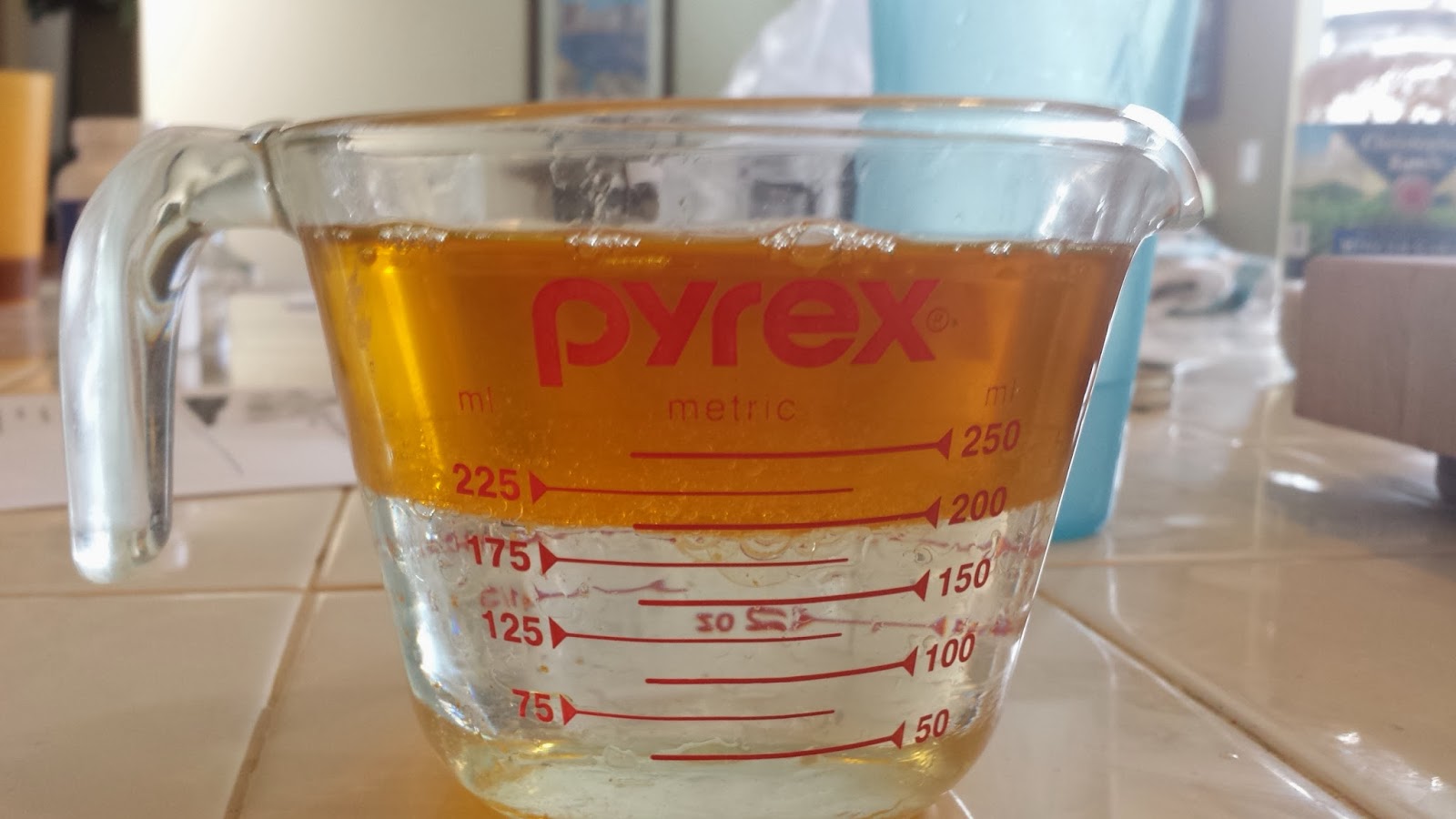
A couple of minutes later, I broke out the fine mesh strainer, and ended up with this -


Yep, 225 ml of oil (that's 7.6 fluid ounces, or just under a cup, for you non-metrics out there).

Oh, and there was a bonus, as well -


Yeah, baby!  Cracklin's!  While still hot, I sprinkled them with some garlic salt.  Tasted just like garlic pork rinds.  Seriously good.  And surprisingly low-cal.

OK, back to task.  You need to make sure there aren't any bits of meat or skin that made it through the screen.  I added water to the oil to get the oil to float, and all of the heavier pieces to drop to the bottom.


I put this in the fridge to chill down for a few hours.  Once is set up, I poked a hole in the top of the solidified fat right near the spout of the measuring cup.  Poured off the water, and scooped the fat into a bowl -


At this point, this is called, schmaltz.  It's used in Jewish cooking as everything from cooking oil, to a spread on toast.  It only had a faint smell of chicken.  It is VERY soft, even when fully chilled.  Kind of like soft butter.  If you touch it, it starts to melt.

On to our candle.  I assembled my tools -


Those would be:  The fat, an empty soda can, a length of cooking twine, a bamboo skewer and poultry shears.

I placed the fat in a pan to re-liquefy, and set it on the stove on the very lowest heat.  While that was working, I needed to make a candle holder.  That would be done with the empty soda can.

In the videos I watched on lard candles, the fat liquefies quickly.  It doesn't have the structural integrity that a candle made of wax possesses.  I was going to use a half-pint mason jar, but decided I didn't want to have to clean it up if I had a failure.

Using the poultry shears, I cut the top off the can higher than the final height -


Not wanting to slice an artery on the rim, I cut down from the top - making a series of tabs -


No, I didn't measure them for exact separation distance, or depth of cut.  Each cut was about an inch deep.  I then folded over the tabs to give me a child-safe lip -


I then tied one end of the twine to the skewer, hung it in the can, then cut the other end so it just touched the bottom.  Filled it up with the now-liquefied fat, and put it into the fridge to set up.


Here's our bad-boy in action -


No in-your-face chicken smell while it burns.  I'm likin' it.

I'll be interested in seeing how the wick works out as it gets closer to the bottom.  As I noted before, this stuff is VERY soft, and I wonder if the wick will tip over.  I'll try and post an addendum at a later date.

UPDATE BELOW

---

OK, for those of you that are thinking, "That fat would be much better used in cooking," - well, you might be right.  Or not.  It might be dark sometime, and you'd be thinking, "Wow, I'm sure glad Chief Instructor showed me how to light up this room with chicken fat..."

Hey, it could happen.

I did some checking, and schmaltz has cooking properties very similar to extra virgin olive oil.

Smoke points (in degrees Fahrenheit)-

  • Schmaltz - 375
  • Butter - 300-325
  • Tallow (beef fat) - 400
  • Lard (pork fat) - 370
  • Veggie shortening (Crisco) - 360
  • Extra virgin olive oil - 375
  • Virgin olive oil - 420
  • Corn oil - 450

Go forth, and render!
---

UPDATE 2/26/14:  As a candle, this is a BIG fail.  After about two hours burning, the entire "candle" was liquefied and the wick slumped into the fat.  No bueno.

On the positive side, the fat is awesome for cooking.  I pan fried some pork chops, and did an Asian stir-fry that turned out great.  I just keep the bowl of schmaltz in the fridge, and take it out when cooking.  Very good stuff that is easy to make.

Also, I like the re-use of the cans.  I'd originally mentioned the paraffin candles I've made in the past.  This weekend, I bartered for about 20 pounds of paraffin, and I'm going to make some emergency candles in the soda can holders.

Bottom line:  Render the fat from stuff that was going to hit the garbage to save a couple of bucks, but eat the fat, don't try and make candles!

---
Share this post! Click the Twitter, Facebook or Google+ icon below, and let your friends know!
Copyright 2014 Bison Risk Management Associates. All rights reserved. Please note that in addition to owning Bison Risk Management, Chief Instructor is also a partner in a precious metals business. You are encouraged to repost this information so long as it is credited to Bison Risk Management Associates. www.BisonRMA.com

Tuesday, January 7, 2014

Tuesday's Charlie Foxtrot

Thank God we're not European (h/t The Woodpile Report),,,

It seems that the European Commission has power over something called, "Plant Reproductive Material Law" -
It will be illegal to grow, reproduce, or trade any vegetable seed or tree that has not been been tested and approved by the government, more specifically the “EU Plant Variety Agency.”
Let THAT sink in:  If you can stick it in the ground and grow it, but some Eruo-crat hasn't blessed the seed, you'll got to jail.  Those crazy, crazy Euros.  It's like they think they have god-powers over nature.  At least we free Americans don't have to put up with crap like that.
---

I spoke too soon...

Oops.  Perhaps like some totalitarian flu bug, it appears as though this god-power has wafted "across the pond" and resides here as well.  In our Supreme Court, no less -
The second case being called to attention is Bowman v. Monsanto.  An Indiana farmer named Vernon Bowman was sued by agri-giant and seed-modifier Monsanto for purchasing seeds from a grain elevator and planting them in his fields.  Monsanto claimed that planting those seeds violated the corporation’s patent rights over them, since they were genetically-modified and considered Monsanto’s intellectual property.  Since Bowman “replicated” the company’s intellectual property [uh, no, he planted them - like you're supposed to do with seeds ...ed], he was sued for nearly $85,000.00 in damages.  Bowman contended that existing patent law did not cover life forms, and that he had broken no laws.  “If they don’t want me to go to the elevator and buy that grain, then Congress should pass a law saying you can’t do it,” said Bowman.
The Supreme Court took up the Bowman case, and disappointingly sided 9-0 with Monsanto.  Rather than accurately declaring that the 120-year-old patent law did not offer any legal coverage of self-replicating seeds as they reproduce in perpetuity, the court made a landmark decision and changed the mechanics of patent law forever without an act of Congress.  This was the very definition of legislating from the bench, and gives corporations the leverage they need to punish consumers for “breaking” laws that don’t really accurately cover modern technologies like genetically-modified lifeforms and computer software.
Suggestion:  Buy your heirloom seeds now (if you haven't already done so).  Kick that GMO crap to the curb.
---

I'm not tryin' to be a dick here (pun intended)...

This just rubs me the wrong way.

It's about a self-defense class.  THAT I love.  What chaps my ass is that it was, "created specifically for the female defender".  What the hell does that mean?  You've got to have breasts and ovaries for the techniques to work?

"Look into my cleavage... you're feeling weak...."

I'm guessing it's all about techniques for smaller, weaker defenders to deploy against larger, stronger attackers.  Hey, there's always some guy bigger than you, and I'm sure they work just as well on smaller, weaker attackers.

Why the need to self-segregate?  Men need not apply.

I think I'll develop a shooting class limited to anyone who can pee standing up without dropping their drawers.
---

Let's see... Prozac or Zoloft...

Hiding from it won't make it go away.  Here are, "11 Nasty Trends That Will Test America's Resilience."

Things in the economy are still crappy, regardless of what Barry and His Merry Band of DC Thieves tells you.  The best thing out there right now is the stock market, but it's a game of Musical Chairs.  Last one standing loses his lunch money.

Stocks have soared because there's nowhere else to put your money (that's not overtly manipulated, like precious metals).  Bonds interest rates have been purposely held down by the Federal Reserve since (it seems like) Truman was in office.  When bond yields increase, money will gush from stocks into bonds like a tsunami.

There's no there there with stocks.  Earnings are either being driven by international sales, or by domestic cuts.  As in people.  For Gods sake, last week's, "first time unemployment claims" was down - to ONLY 338,000 THAT WEEK, and the stock market reacted like it just got a hit of Viagra.


Folks, get that second stream of income up and running.  Now.  What's the worst that can happen?  You've got some extra cash in the bank?

---
Copyright 2014 Bison Risk Management Associates. All rights reserved. Please note that in addition to owning Bison Risk Management, Chief Instructor is also a partner in a precious metals business. You are encouraged to repost this information so long as it is credited to Bison Risk Management Associates. www.BisonRMA.com

Thursday, January 2, 2014

Chicken Feed

I'm off for a road trip to another state in search for property that does not contain a California zip code.  My wife and I have narrowed the areas in this state where we'll consider moving, and now we're fine-tuning the search to the district and neighborhood level.

Exciting times!

One of the considerations is the ability of the property to support us with food.  Water and land for vegetables, fruit trees and berries, and enough space to have a few meat animals.  Chickens and rabbits will most likely be on the menu!

Having never raised either of these, I'm obviously curious to understand the cost of raising these animals specifically to be slaughtered (plus eggs from the hens).

This article ("Cost of raising chickens in 2014") offers a glimpse into the ongoing costs of raising chickens and other fowl.  Quite interesting stuff.

I've read a number of books on raising chickens and rabbits, but this is the first, "real time" cost estimates I've seen.

For those of you with chickens, do these numbers seem reasonable?

For me, cost is only part of the reason we'll be raising meat animals.  The primary reason will be for self-sufficiency.  Chickens will cost $100 a pound if the local Safeway has its supply chain interrupted!

On a related note, my wild pig hunt has been rescheduled.  We're heading into the wilds in northern Sonoma county in late January.  Wild pigs in California have no bag limit, and no season.  Take 'em when you want, and as many as you want.  Most land owners consider them to be vermin.

The young man that's obtained access to this land has indicated we're welcome to hunt there as often as we'd like.  We'll see how this first hunt turns out, but if all is good, the pork aisle at the local supermarket may never see me again!

Accept The Challenge

If, for whatever reason, your local supermarket is unable to obtain food to sell, what would you do?  How would you provide for yourself and your family if we had a disruption of 3 months?  6 months?  Two years?

Could you provide for yourself, or would you become a ward of the state?  A FEMA camp "guest"?

No problem.  It looks like they have plenty of space left.


Skills and the proper resources will keep you alive and free.

---
Copyright 2014 Bison Risk Management Associates. All rights reserved. Please note that in addition to owning Bison Risk Management, Chief Instructor is also a partner in a precious metals business. You are encouraged to repost this information so long as it is credited to Bison Risk Management Associates. www.BisonRMA.com

Monday, September 2, 2013

Some Projects For You To Labor Upon

Happy Labor Day, by the way....

Maybe a couple of these ideas found at Instructables.com will click in your head as a way to make a couple of bucks on your way to developing a second stream of income, or to help your preps be more productive or and less costly.

This is a great example of using a bit of elbow grease and only a little bit of money to seriously upgrade and improve an existing pile of crap.

This smoker went from this $5 garage sale find:


To this - dare I say - smokin' work of art:


Think you could make a couple of bucks selling this?

If you've got some welding skills and a bit of artistic flare, this Instructable details how to turn a bit of square tubing and flagstone into some remarkable - and unique - tables.


Based on the information in the Instructable, the materials for this table cost less than $50.  That's an easy $500 table, and some of them online go for north of a thousand bucks.

Perhaps you're like me and you work with wood.  So make an oak base!

On the prepper's side, one of the big contributors to Instructables is this guy named the King Of Random.  This guy is unreal.  He has posts on everything from homemade stuff that goes 'boom' to a post like this that shows you how to very easily make a water pump from PVC pipe.


Finally, this last one is a big time saver for those of you with gardens.  Many of you may already know of this trick, but it's a new one to me.

Get your seeds to sprout faster  - as in overnight - by abusing them!

Using a technique called, "scarification", you remove part of the seed hull before you apply water for them to sprout -


He claims he gets a 60% overnight success rate....


Now, get a-laborin'!

---
Copyright 2013 Bison Risk Management Associates. All rights reserved. Please note that in addition to owning Bison Risk Management, Chief Instructor is also a partner in a precious metals business. You are encouraged to repost this information so long as it is credited to Bison Risk Management Associates. www.BisonRMA.com

Thursday, June 20, 2013

Of Pork and Partially Hydrogenated Oil

I recently made a purchase of a couple of long-term food items, and decided to share my experience with both.  Both items were purchased from MREDepot.com.

The first was freeze dried pork chops.  It seems they got hold of some chops that had been originally made for some "higher ups" in our government.  This isn't the stuff given to the soldiers in the field, which kind of pissed me off the more I thought about it.

Anyway, the chops come in No. 10 cans with a content weight of 23 ounces.


 Their website says each can comes with between 15 and 20 chops, depending on size.  The can I opened (I bought a 6-can case) contained 20 chops.

The instructions tell you to soak the chops in warm, salted water for 20-30 minutes (or if possible, overnight to "equilibrate" the moisture), then cook and eat (BTW, the chops are raw and MUST be cooked).  For my test, I took 8 chops, put them in a bowl of salted water, and the chops floated.  I placed a plate on top to keep them all submerged.

Instead of waiting the recommended 20-30 mins, I let mine soak for a full 60 minutes.  I took them out, patted them dry of surface water, and let them sit covered for another 60 minutes.

I dredged two of the chops in flour and panned fried them up.  The results were iffy at best.

The 60 minute soak and 60 minute rest were not enough to fully rehydrate the chops.  They were edible, but just barely -


The meat was tough to cut (NO, I didn't over cook them), and was very stringy.  Flavor, though, was OK.

The next day, I took two more of the chops which had been in a ziplock bag in the fridge.  I did the same flour dredge and pan fry.  Quite a difference!


These chops, you'll notice, have none of the stringiness.  I cut the chop with and against the grain.  Seriously, very little difference (if any) from a fresh chop.  Flavor, texture and mouth-feel were awesome.

Now, let's talk value.  The 8 original chops weighed 9.2 ounces straight out of the can.  After rehydration, they weighed 19.7 ounces.  Doing a little math, that means that the whole can of freeze dried shops - which started at 23 ounces - will produce right around 49 ounces, or 3 pounds of rehydrated chops.

They are currently sold for around $48 per can, or $16 per pound when rehydrated.  Pricey, for sure, but for my money, it's a hell of a deal if you're in a SHTF scenario where you've been eating little more than rice, beans and jerky.  The mental uplift of eating a real chop would be huge.  The stuff lasts for 25 years, so it's one of those things, which for all practical purposes, will never need to be rotated.

I could see these being used while backpacking as well.  After setting up your base camp, throw some chops in water, let them sit a day, and have an awesome meal to look forward to.
---

The second item I purchased was powdered shortening.  I had VERY high hopes for this stuff.  Their website noted that the powder could be sprinkled in a pan - which would cause it to melt - and you could fry up your food.


 Here's a screen clip with the "how to" for the powder (click to enlarge) -

I'm thinking, "Finally, a light-weight, portable fat that can be used for frying!  No more lugging lard or bottles of heavy oil!"

Absolute.  Total.  Failure.

I sprinkled some of the powder in a cold pan, turned the heat on medium, and waited for the powder to melt.


And waited.

And waited.

Finally, the powder started to brown (WTF?).  No melting at all.

I wiped out the pan, sprinkled in some more powder, and put the heat on low.  Same thing.  More browning, no melting.

I followed their instructions to make up some of the shortening.  One-third cup of water and one-half cup of the powder.  Mix well.  I ended up with this -


 Kind of a very thin slurry, not a solid shortening.

I put some of the slurry into a pan, thinking maybe their "sprinkle" instruction meant it had to be done with the wet stuff.

Not so much.  Just some bubbling, then - you guessed it - browning.  It never melted into an oil with which I could pan fry.

Very, very disappointed.
---

I wish MRE Depot would just be straight about both of these products.  For the chops, stress that they MUST be soaked overnight for them to act like real chops.  Sure, you can eat them after 20 minutes, but I can also say I can eat a bag of dried beans like popcorn if I wanted.

This is a great product, and I will likely buy more because of the high quality.  There is no need to try and make this stuff something it's not:  an instant chop.  Like the aforementioned dry beans, for them to have their expected texture and flavor, they've got to be soaked for HOURS.  It is what it is.

With regards to the shortening, IMO, it failed miserably.  I was relying on their statement that it would liquefy when sprinkled in a pan.  Not even close!  It may work wonderfully in baked goods, but those won't be high on my hit parade during a SHTF situation.  Having a light-weight cooking "oil" that I could have in my stores (and perhaps in a BOB) was what I was looking for, and which I was promised.

Like the chops, MREDepot appears to be trying to be all things to all people.  This stuff simply does not melt in a low, medium or high heat pan.  Don't tell me it will!

---
Copyright 2013 Bison Risk Management Associates. All rights reserved. Please note that in addition to owning Bison Risk Management, Chief Instructor is also a partner in a precious metals business. You are encouraged to repost this information so long as it is credited to Bison Risk Management Associates. www.BisonRMA.com

Thursday, June 6, 2013

Bullets And Butter

 Well, mostly butter.

I'm planning on making a dent in the California wild pig population in a couple of months.  I've got a buddy that reloads his ammo.  He got tired of hearing me bitch and moan about how I was having a difficult time securing enough .308 for one of my rifles, and offered to teach me how to make my own.  After a bit of haggling, we cut a deal.

I was over in his garage building cartridges, and he decided to use his time more efficiently than watching me while I worked one of the machines.  He went inside, grabbed a one quart mason jar, filled it a bit over half way with heavy cream, and proceeded to make butter.

I'll be damned if he didn't have a glob-o-butter in about a half hour!

So, today, I bought a couple quarts of heavy cream to attempt to repeat his act.  Success!  It's crazy-easy, and I swear, it tastes WAY better than the store-bought stuff.

I followed his lead, and filled a quart mason jar about half full - a bit less than he had done.  And then I started shaking.

And shaking.

And shaking.

The cream goes through a couple of stages on its way to becoming butter.  You first get a weak whipped cream.  Then a stiff cream.  At this point, you don't hear or feel a lot of stuff sloshing around in the jar.  After 20 minutes or so, the cream "breaks" into butter and skim milk.


You then pour off the skim milk, and shake some more.  Repeat as necessary.  Here's the view from the top -


You take the blob of butter and put it into a bowl.  There's still milk in the butter, and if you leave it there, it will make the butter go bad more quickly.

Add cold water to the bowl of butter, and start mashing the blob with your hands.  The water will go cloudy.  Pour that out, and repeat until the water stays clear.  You'll then end up here -


I then took a wooden spoon and mooshed everything around some more.  The butter will "leak" more water and milk.  I just used a paper towel to sop it up.  When done, I ended up with just under a pint of skim milk, and 13.7 ounces of butter!


I returned the butter to the stainless bowl, added 1/2 tsp of salt and mooshed it around some more.

Holy crap, what awesome stuff!

Still, I'm not sure it was worth the effort (other than knowing I can now turn cream into butter - not a bad skill to have).  Forty-five minutes, all in.  So, I went to the Internet and found a couple of sites on making homemade butter (Seriously, there were 240 MILLION entries on Google.  Am I the last person in American to make his own butter?)

One that caught my eye used a KitchenAid mixer - my second favorite appliance (right after my sausage stuffer).

I poured the cream into the bowl, attached the balloon whisk, and turned it on.  Medium speed to start - until the cream frothed up a bit - then I cranked it.  After about two minutes, I turned it off to scrape down the sides of the bowl.  Two minutes later, I did the same again.

After about 7 minutes, I had this -


If you look closely (click it to enlarge), you can see the separated skim milk at the bottom.

Boo-yah, baby!  Butter in 7 minutes!  I just followed the same steps as with the post-jar manual process (cold water, etc.), and ended up with exactly the same amount of butter....

Which posed a bit of a problem.  I now had over a pound and a half of butter.  In a household that eats about a quarter pound every two weeks (hey, I'm an olive oil kinda guy), that's a lot of butter!

So, I decided to make some of it into a compound butter.  These are just butters that have other herbs and flavors added.  I was going to make a seafood butter with some dill weed I had picked up for an upcoming pickled bean project, but decided to go more generic.  I decided to just make a parsley and garlic butter.

I took 4 cloves of garlic and smooshed them into a paste.  I added that to a half pound of the salted butter, and about half teaspoon of dry parsley.

I laid out a sheet of plastic wrap and plopped down the butter mix -


I rolled up the butter into a tube about the height of a silver dollar -


That was then wrapped up in aluminum foil, and wound up pretty tight so I'll be able to slice off nice medallions of butter.


I figure the garlic butter will work with fish, chicken, beef and pork.

Speaking of pork, here's a little bullet porn that will be used to acquire those chops-on-the-hoof - 

 ---

Mrs. Chief Instructor just got home and went nuts over the butter.  Two thumbs up!

And yes, I AM the last person in America to make his own butter.  My wife proceeded to tell me that her 5th grade students make butter in baby food jars every year.

At least I'm ahead of most of the 4th graders...


---
Copyright 2013 Bison Risk Management Associates. All rights reserved. Please note that in addition to owning Bison Risk Management, Chief Instructor is also a partner in a precious metals business. You are encouraged to repost this information so long as it is credited to Bison Risk Management Associates. www.BisonRMA.com