As some have noticed, my writing frequency here has dropped considerably. And changed a bit.
For the past couple of months, I've been writing preparedness and homesteading posts over at BoomerPreps.com. I even borrowed a couple from here! A group of us have been working our tails off trying to put together a "go to" site on preparedness issues and techniques - initially targeted towards Baby Boomers - hence the name.
And while those of us who are a bit less physical, and a bit less quick, and a bit more experienced are the primary focus for the site, we've expanded our scope to encompass anyone that just wants to put forth the effort, with the goal of improving their personal independence.
We've got a great group of writers - always looking for more (hint, hint!) - hoping to give a wide variety of viewpoints and perspectives on this very important goal.
I invite you to drop on by, kick the tires, leave a comment or two and see how you like the joint. We are always open to suggestions on content, topics and the like. Let us know what you're looking for.
Unlike this site, the content is strictly, "how to". If you enjoy my weekly (or so) rants on the politics of being prepared, keep coming by here. I need to blow off some steam now and again!
A request (or 3):
1. Join our mailing list (under the big hand on the home page - follow the finger...). We keep you up to date on new articles and information (free and premium) added to the site. We give you our blood oath we will never, ever give, share, sell, trade or barter your address to any other party. Never.
2. If you have a website or blog, please give us a link. Thanks in advance.
3. If you have a Facebook, Twitter or Google+ page, please like us, follow us, or join us, as the case may be. Our Facebook and Twitter feeds will be the only place we ever delve into politics for the site!
Your continued support is much appreciated.
---
Share this post! Click the Twitter, Facebook or Google+ icon below, and let your friends know!
Copyright 2014 Bison Risk Management Associates. All rights reserved. Please note that in addition to owning Bison Risk Management, Chief Instructor is also a partner in a precious metals business. You are encouraged to repost this information so long as it is credited to Bison Risk Management Associates. www.BisonRMA.com
Showing posts with label 12 Impacts. Show all posts
Showing posts with label 12 Impacts. Show all posts
Monday, September 29, 2014


Monday, December 31, 2012
Skills: 12 For '13
Like most folks, when the end of the year rolls around, I start making lists of things I want to get done for the coming year. I personally find that if I make lists, I tend to do much better hitting my marks.
So, in the spirit of giving, I'm not going to give you a specific list, but some guidelines. Using our "12 Impacts" approach to prepping (there are only 12 possible impacts from any sort of emergency or disaster), here are some ideas for skill building everyone should consider for 2013.
Note, it's skill building, not going out and buying a gadget. Gadgets can get lost, stolen, or fail. Skills give you the ability to adapt to your circumstances.
Come on - it's not that tough. Build one new skill once a month.
Push yourself! Develop skills in areas where you suck. If you're a big gun guy, don't learn 6 new ways to hide a pistol on your person. Instead learn how to set a broken bone, or make a shirt from cloth and thread.
I've got posts on a number of these items, which you can read by clicking here.
Broaden your horizons. Try to do one out of each category. For most folks, number 10 will be the most difficult, so make sure you do it! Barter and negotiating are outside of the comfort zone of so many people. Remember: The worst that will happen is the person you're negotiating with will say No.
Or would you rather try dumpster diving, or gathering recyclables? I've got to tell you, we have a growing number of folks coming into my precious metals store doing the whole, "hunting and gathering" gig with all types of recyclables, including gold and silver trinkets they find. Most are earning a couple hundred dollars a week through all of their finds. Great skill and a great way to build your war chest for buying prepping gear you can't negotiate for.
Here's the list and some suggestions to get your juices flowing...
So we look a probabilities, at least in the beginning. Once we acquire some skills, goods and equipment, we tend to increase our resources to cover more dire events. It never seems as though anything is enough. I don't know if this is good or bad, it just is.
---
Copyright 2012 Bison Risk Management Associates. All rights reserved. Please note that in addition to owning Bison Risk Management, Chief Instructor is also a partner in a precious metals business. You are encouraged to repost this information so long as it is credited to Bison Risk Management Associates. www.BisonRMA.com
So, in the spirit of giving, I'm not going to give you a specific list, but some guidelines. Using our "12 Impacts" approach to prepping (there are only 12 possible impacts from any sort of emergency or disaster), here are some ideas for skill building everyone should consider for 2013.
Note, it's skill building, not going out and buying a gadget. Gadgets can get lost, stolen, or fail. Skills give you the ability to adapt to your circumstances.
Come on - it's not that tough. Build one new skill once a month.
Push yourself! Develop skills in areas where you suck. If you're a big gun guy, don't learn 6 new ways to hide a pistol on your person. Instead learn how to set a broken bone, or make a shirt from cloth and thread.
I've got posts on a number of these items, which you can read by clicking here.
Broaden your horizons. Try to do one out of each category. For most folks, number 10 will be the most difficult, so make sure you do it! Barter and negotiating are outside of the comfort zone of so many people. Remember: The worst that will happen is the person you're negotiating with will say No.
Or would you rather try dumpster diving, or gathering recyclables? I've got to tell you, we have a growing number of folks coming into my precious metals store doing the whole, "hunting and gathering" gig with all types of recyclables, including gold and silver trinkets they find. Most are earning a couple hundred dollars a week through all of their finds. Great skill and a great way to build your war chest for buying prepping gear you can't negotiate for.
Here's the list and some suggestions to get your juices flowing...
- No Potable Water - build a sand and charcoal filter; make charcoal; make a solar still; learn how to locate water in all types of terrain;
- No Food - learn the local edible "weeds" and other flora in your area and make a salad; learn how to make 3 kinds of snares; learn to kill and clean a fish; learn how to kill and clean a small mammal; ferment food scraps into alcohol;
- No Shelter (from elements) - build and test a debris shelter; learn the knots necessary to set up a tarp shelter, then set one up; sew together a simple hat from some simple cloth; learn to water proof cloth;
- Lack of Safety and Security - learn to accurately shoot one handed; learn to shoot with your weak-side hand; learn basic striking techniques for quickly disabling an attacker; learn about boobie traps and early warning devices; learn to load your own ammo
- No Public Utilities (electricity, gas, sanitation) - learn 2 ways on how to make fire without using matches or lighters; learn how and where to make an outdoor toilet;
- No Communication Services - learn about and practice a "dead drop"; become a ham radio operator; learn Morse code;
- Toxic Airborne Contaminants - make a homemade gas mask; learn to "air proof" a room in your home;
- Restricted Travel - make a drag sled; map a route through a city that bypasses all public and private cameras; hike 10 miles with a pack equal to 50% of your body weight; learn how to siphon gasoline; learn how to use a compass; learn how to read and use a topographical map;
- No Access to Professional Medical Services - learn indigenous medicinal plants and how to prepare them; learn how to set a compound fracture; learn how to clean and close a wound; learn how to stop bleeding; learn how to open a breathing channel;
- No Money - practice bartering (without using cash) at garage sales and flea markets; learn how to dumpster dive; identify and collect the most abundant and the most valuable items in your area that can be gathered and sold to recyclers;
- Lost Records - make a "Survival Bible" and put it in paper and electronic media; make copies of your most important documents - driver's license, birth certificate, mortgage papers, etc. - and put them in a geographically distant location;
- Mental Health/Spirituality - learn and store games that need no electronics (dice, cards, board games); learn games that need no tools (hide-n-go-seek, for instance); memorize important passages from your religious text of choice; learn about and gather flora that contains calming/soothing properties; learn 5 yoga poses;
So we look a probabilities, at least in the beginning. Once we acquire some skills, goods and equipment, we tend to increase our resources to cover more dire events. It never seems as though anything is enough. I don't know if this is good or bad, it just is.
---
Copyright 2012 Bison Risk Management Associates. All rights reserved. Please note that in addition to owning Bison Risk Management, Chief Instructor is also a partner in a precious metals business. You are encouraged to repost this information so long as it is credited to Bison Risk Management Associates. www.BisonRMA.com
Sunday, June 27, 2010
The Summer of Our Discontent

The lid is blowing off in Canada. Anarchists are being arrested left-and-right for turning peaceful protests into violent mob scenes. So far, more than 500 have been locked up, a portion of which are peaceful protesters or simply people watching the mess and getting swooped up in a police dragnet.
Bangladesh is rioting because of the "misrule and failure" of their government (hmmmm). Chinese workers are striking. Young people in France are protesting because the government has told them their retirement age is going to go up. We already know what's been going on in Greece.
Here in the good old US of A, we have had buckets-o-protest over Arizona's immigration laws. The law goes into effect on July 29th. Expect to see MORE protests ("National Day of Non-Compliance").
In fact, starting tomorrow, there is a "30 Days For Human Rights" deal leading up to the big crescendo on July 29. They have a calendar on their site, but it's empty, so I've signed up for their email updates. Should be interesting...
We're seeing protests against BP for the oil spill (great images of protest signs). So far, they look non-violent, but I know that if I lived on the Gulf Coast, I'd be quite bent out of shape even if I weren't in the oil or fishing industry. BP and the Federal Government have really screwed this one up quite well.
The BART cop trial is expected to wrap up very soon - perhaps going to the jury as early as this week. As I've said before, if he's not found guilty of murder - rightly or wrongly - the protests will be wide-spread and very violent.
More than a year later, emotions still run high.Accept The Challenge
Oakland police and city leaders fear the possibility of violence when a verdict is announced.
Last week, the city's Police Department simulated a riot to help officers prepare for unrest. Meeting areas are being set up for residents to peacefully express their feelings about the verdict. And preachers have agreed to urge calm.
"Whatever the verdict, it's sure to raise a lot of emotion. It touches an issue that's very deep in the community," said city spokeswoman Karen Boyd.
A spokesman for the Los Angeles Police Department said special preparations were in the works for any post-verdict crowd gathering outside the downtown criminal courts building, but he declined to elaborate.
"We are not going to go into any sort of detail on our planning other than to confirm that we are working with court security and are prepared to handle any gathering of crowds outside of the courthouse, when a verdict is returned," said Lt. John Romero.
Have you got an Evacuation Plan (Part 1, 2, 3) and Shelter-In-Place plan? Unless you're one of the lucky few that live out in the boonies full-time, you need to consider each of these over the next few months. Tighten them up, review your evacuation routes, be sure your BOBs are complete.
Don't end up a victim!
Obviously, review your Safety and Security plans as well. A big part of that (should be) safety awareness. Knowing or being able to anticipate problems by following the news or the Internet on potential "hot spots" will take you a long way in staying safe.
Remember: The best way to avoid an emergency is to not be there!
Photo Credit: REUTERS/Mark Blinch
---
Please click our advertiser links. They pay us so you don't have to. A click a day is all we ask!
Copyright 2010 Bison Risk Management Associates. All rights reserved. You are encouraged to repost this information so long as it is credited to Bison Risk Management Associates. www.BisonRMA.com
Wednesday, June 16, 2010
Electronic Armageddon
Explorer on the National Geographic Channel had a show last night called, "Electronic Armageddon." The show is on the possible impact of a natural or man-made disaster that takes out our electric grid.
Sobering stuff.
It's on again this Saturday, 6/19.
---
Please click our advertiser links. They pay us so you don't have to. A click a day is all we ask!
Copyright 2010 Bison Risk Management Associates. All rights reserved. You are encouraged to repost this information so long as it is credited to Bison Risk Management Associates. www.BisonRMA.com
Sobering stuff.
It's on again this Saturday, 6/19.
---
Please click our advertiser links. They pay us so you don't have to. A click a day is all we ask!
Copyright 2010 Bison Risk Management Associates. All rights reserved. You are encouraged to repost this information so long as it is credited to Bison Risk Management Associates. www.BisonRMA.com
Friday, June 11, 2010
What More Motivation Do You Need?

Uhm, not so much. Some agencies are apparently more concerned with matters other than terrorism. As you'll see below, some of them seem more focused on publicizing job openings than offering information on what people can do in the case of a terrorist attack.
Prepare shake your head so violently that you hurt your neck!
A recently release report from the Justice Department Inspector General says they aren't ready for diddly-squat. Not even close -
I speak of the report from the Inspector General of the Justice Department, issued in late May, saying the department is not prepared to ensure public safety in the days or weeks after a terrorist attack in which nuclear, biological or chemical weapons are used. The Department of Homeland Security is designated as first federal responder, in a way, in the event of a WMD attack, but every agency in government has a formal, assigned role, and the crucial job of Justice is to manage and coordinate law enforcement and step in if state and local authorities are overwhelmed.So, no law-and-order if things get a bit dicey. Nice.
The paper also quoted Randall Larsen, the former executive director of the commission that gave the government low marks in January: "They just don't see the WMD scenario as most likely," he said.Al Qaeda, Hamas and any of the thousands of groups that want us dead, are smart enough to know that they can't attack us mano-a-mano. We'd crush them if we fought a traditional war.
They don't? They must be idiots. They must not be reading all the government reports of the past eight years, declaring terrorist attacks on U.S. soil not only likely but virtually certain. There are many reasons for this, and just one has to do with something Ronald Reagan mused about in his office 25 years ago. "Man has never had a weapon he didn't use," he said, to a handful of aides. If you develop the atom bomb, it will be used, as it was. If man, in his darkness, can develop and deploy nuclear, biological and chemical weapons, they will be used, too.
They employ the tactics of Asymmetrical Warfare. They understand that they have to fight "dirty". They find someone willing to strap on a chest full of dynamite - knowing full well he will lose his life - towards the goal of killing a couple dozen enemy soldiers. A one-for-ten or one-for-thirty ratio is pretty damned good.
WMDs are considerably more difficult to build and deploy, but these terrorists have had nearly 9 years to work out the bugs. We know that the first step - getting into our country undetected - is a piece of cake. They've had plenty of time to work out the details of how to strike again.
Like 9/11 - a WMD attack that cost 20-odd terrorist lives in exchange for 3000+ US lives - a number of coordinated, targeted attacks on key infrastructure could be devastating. Water delivery, communications, food distribution - pick a target.
I used to wonder about why they wouldn't use airplanes again. I used to be an Oakland Raiders season ticket holder (I dropped the idiots this year.... who's been the idiot?!). The Oakland Coliseum is within a stone's-throw of Oakland International Airport. We'd have planes buzzing over the stadium all the time, pulling advertising banners behind them.
Imagine the panic and terror that would be caused by someone who hired a private pilot for the day, cut the pilot's throat or shot him in the head, and "aimed" the plane into a stadium full of fans?
The cost? One dead terrorist, one dead pilot, one crashed rented plane and hundreds if not thousands of dead fans.
But the terror impact would be the big bonus. Seeing planes acting like lawn darts as the slammed into the stadiums would be horrific. Airports across the country would be shut down. Football would likely cancel the season, or at least a part of it.
If the wing-nut in North Korea or Iran decides to get ugly, a nuke could be sent our way. What then?
No one wants to think about it. I don't want to think about it. But you have to make plans. You have to imagine, you have to think about the worst case, and then you have to plan for it—literally. We've had enough time, nine years since our unforgettable reminder that history is, among other things, and some of them quite wonderful, a charnel house.---
...
You can see a certain air of complacency even in government websites. On the front page of the House Committee on Homeland Security site there's a picture of Chairman Bennie Thompson, a Mississippi Democrat, then, below, an area devoted to something called "Business Opportunities Model" and an area for "DHS Business Opportunities." On the Homeland Security Department's website, the priorities seem equally clear: "Find Career Opportunities," "Use the Job Finder." There's little sense of urgency; it's government as employment agency, not crisis leader.
Honestly, I don't know what the Justice Department could really do. If some SHTF event occurs, we're all going to be on our own - at least for a good period of time.
I noted in one of my last posts that when the Rodney King verdict was announced in LA, there was rioting for 6 days. What I didn't mention was that it took 3 days for the California National Guard to get on site. Three days to secure one area of America's second largest city. And this was while no other disaster was in play. What kind of response could be expected if it were some sort of wide-spread attack?
If something big and bad happens, and you're out in the boondocks, I hate to break it to you, but they ain't comin'. You're on your own.
Accept The Challenge
Before you proceed, go read this post ("Twelve Disaster Impacts") to help you get a handle on what you need to plan for.
A post like today's should open your eyes about what personal security issues you need to address. If something major were to hit us, YOU, and you alone will be responsible for your safety. The cavalry will not be riding in to save your bacon, so to speak.
There are so many events that could occur that would put you in this position. A devastating hurricane like Katrina. Civil unrest like the Rodney King verdict caused. Another coordinated terrorist attack like 9/11. An earthquake like the ones in Haiti or Chile. In both of those instances, the looting and rioting started almost as soon as the ground stopped shaking.
If you haven't heard it, listen to this interview of Gerald Celente of Trends Research on how he survived the Chilean earthquake, and about how quickly the lawlessness started.
"What's normal isn't normal any more." Indeed.
In the best of cases, government is slow to react. With Katrina, we knew days in advance that it was coming, the Feds declared a Federal Emergency before it even hit, yet we all saw how that turned out.
What could you possibly be waiting for?
---
Please click our advertiser links. They pay us so you don't have to. A click a day is all we ask!
Copyright 2010 Bison Risk Management Associates. All rights reserved. You are encouraged to repost this information so long as it is credited to Bison Risk Management Associates. www.BisonRMA.com
Monday, June 7, 2010
Preps: No Communications Services, Part 2

As we noted in Part 1, the first scenario already happens every single month somewhere in the United States. Honestly, if you don't have plans and equipment to address the first scenario, you're so far entrenched in the, "someone will take care of me" mentality, that you most likely are not a regular reader of this blog!
Scenario 2: Wide-spread, regional disaster. It could be the result of a massive natural disaster, or a deliberate act of semi-localized terrorism where key communication infrastructure sites are disabled.
The likelihood of cell/text/email/internet service is extremely low. Assume you'll be going "old school".
Minimum Gear/Equipment: All of the gear/equipment from Scenario 1, plus: Short-wave radio, flares-glow sticks and signalling mirror, whistle, CB radios.
Also consider: Learning Morse Code, two-way radios ("walkie-talkies")
Having a communications plan as a part of your overall emergency plan is paramount. (The general principle of what follows was gleened from some other prepper site which I can't remember for the life of me. If anyone recognizes it, let me know, and I'll gladly give attribution):
Let's say your emergency plan calls for your family/group to go to Site B based upon the emergency at hand. Your route to the site is pre-determined - with alternatives - and has "rally points" where messages can be left (and where supplies can be cached).
No one in your family/group knows if you're OK, or if you're on the way to the site. You can let them know by employing pre-assigned signals. Each person is assigned a geometric symbol. Dad is a triangle, mom is a circle, sis is a diamond and bro is a star.
You also have pre-determined information symbols to indicate physical condition, danger, alternate directions and supply levels. For instance, dad is first to reach the first rally point. When he leaves the site, he marks the agreed upon place with his triangle. He puts the date below the triangle. He also draws a straight line below it, indicating he is in good health.
Right below that, he writes "S+" indicating he has plenty of supplies with him to make it to Site B.
He walks a few miles along the planned route and observes a road block manned by some Mad Max types. He turns around and returns to the last rally point. He writes a "2" in the center of his triangle symbol, indicating he is now using the alternate route to Site B. He also writes a series of X's and an arrow pointing in the old direction indicating "danger ahead".
Mom and sis then arrive at the rally point a few days later. They see dad's signal to take the alternate route. They write their symbols and the date, and put a "2" in the center of each indicating they're taking the alternate route as well. Sis puts a straight line under her symbol indicating she has good health, but places a wavy line under mom's, indicating she is ill or injured in some way. They also put an "S-" symbol indicating they are both low on supplies.
---
Keep abreast of events using the standard radio. If this does not get a signal, the short-wave should be able to pick up a signal, albeit likely from a longer distance away, plus they can pick up "ham" radio signals.
CB (Citizen Band) radios give you the ability to speak and listen to anyone that happens to be on one of the 40 possible channels at the time. There is no ability to speak privately with another person on these radios - what you say is heard by anyone close with a CB tuned to that channel.
Walkie-Talkies CAN give you some privacy, but even encrypted devices can be "hacked". Generally, the distance between radios must be much closer than it is for CBs. They do give a small group the ability to stay in contact more easily (and semi-privately).
The flare, light sticks, whistle and signaling mirror are all used to bring attention to yourself and indicate distress. If you have the ability to build a fire, green boughs thrown on a fire make a great deal of smoke, and act as a very effective signal as well.
Scenario 3: An EMP (Electromagnetic Pulse), CME (Coronal Mass Ejections - "solar flare") or similar catastophic event. All public communcications services are out of service for extended periods of time, possibly forever.
These ares VERY bad. If it's from an EMP, it means we've been attacked with at least one nuclear weapon. It may have been a one-off shot by a country such as Iran or North Korea. Or it could be the first salvos in a much bigger and nastier war.
With an EMP/CME, remember that it will not only be communications equipment that dies, it will be all electronic equipment. Cars, refrigerators, airplanes, etc. - anything with a transistor in it. Both the electronic equipment and the power grid supplying the electricty are fried.
Minimum Gear/Equipment: Everything listed in Scenario 1 and 2, plus: Non-Transistor (vacuum tube) communications equipment, "hardened" equipment or equipment shielded by a Faraday Cage. Ham radios or other similar two-way communications capabilities.
With the first two scenarios, the equipment needed could be carried with you in a ruck sack. For this last scenario, we're moving into "base station" types of equipment.
And just in case you're saying to yourself, "Uhm, Chief, I think you may have your tinfoil hat screwed on a little bit TOO tightly...", CMEs happen, and they're unpredictable.
There was a massive CME in 1859 that was so strong, they saw the Northern Lights.... in Cuba. Obviously, we dodged a bullet at that time, since we were technological infants, so to speak.
In March 1989, a solar storm much less intense than the one in 1859 caused Quebec to go dark for over nine hours.
---
What is a Faraday Cage? Basically, it is a metal box that absorbs the electrical charge and diverts it away from the equipment being protected. These can be made fairly easily and inexpensively using a large metal can, such as those used to hold the big batches of popcorn you usually see in the stores around Christmas.
The key is ensuring that the equipment you are protecting does not touch the metal can. Wrap your small equipment pieces in a number of layers of newspaper. Pack the bottom of the can with some sort of insulating material - crumpled up newspaper, for instance - place in your wrapped equipment pieces, making sure each piece has insulation above, below and on each side. Put the lid on the can and store it away.
To improve the efficiency of the "cage", tape a wire to the outside of the can, and attach (ground) it to a large metal structure, such as a metal rack or metal plumbing.
As an aside, those of you that have back-up generators or solar/wind systems are at risk as well. Do some research on what needs to be done with regards to properly grounding/hardening your life-saving power generating equipment.
Accept The Challenge
If you are going to make a communications plan that employs symbols, obviously you will need to share and discuss the various symbols and their meaning. Think of as many contingencies as possible. How will you indicate you're going to a back-up site? How will you indicate someone has been captured, killed or is missing?
Putting together a Faraday Cage for a handful of basic communications (and other small electronics) is relatively easy and inexpensive to do.
For a fictional story that has a plausible storyline for the outcome of an EMP or large CME, I recommend you read, "One Second After".
***UPDATE*** It seems that NASA is getting a bit nervous about CMEs as well.
---
Please click our advertiser links. They pay us so you don't have to. A click a day is all we ask!
Copyright 2010 Bison Risk Management Associates. All rights reserved. You are encouraged to repost this information so long as it is credited to Bison Risk Management Associates. www.BisonRMA.com
Friday, June 4, 2010
Preps: No Communications Services, Part I

This is the eighth out of the twelve impacts. We've also done a 3-part post on Evacuation Plans (I, II, III) and a Shelter-In-Place Plan (SIP).
We're going to drill down into one of the twelve impacts: No Communication Services.
---
You have no or limited access to modern electronic communication services.
We have become wholly dependent upon instant communications. We use telephones to keep in touch with others. We log on to the Internet to purchase goods and services. We use our cell phones to call for emergency services when needed. Email, blogging, social networking and texting are omnipresent.
This also includes one-way communications, such as television and radio. Devising alternative means of communication allows you to stay advised as to the severity of an event, and establish plans to react to the impact.
Possible Impacts:
- Learning about emergencies - If access to television and radio are not available, you will be unable to determine the depth and breadth of the incident, and be unable to implement the various aspects of your emergency plans. Without phones/Internet/email, similar “information isolation” occurs. You are unable to ascertain the cause and effect of an emergency, and whether it is subsiding or escalating.
- Communicating with family and friends - Aside from the emotional stress of not knowing the whereabouts and health of family and friends, you are unable to render assistance or resources if they are in need.
- Communicating with government authorities - 911, etc. You place yourself in a position where you are unable to obtain assistance for crime, fire and medical assistance.
Scenario 1: There has been an earthquake/hurricane/flood/terrorist attack/tornado, and communications services are available, but inconsistent. Somewhere in America, this type of impact happens every month of every year.
Minimum Gear/Equipment - Cell phone, emergency phone list, pad of paper, pen, Sharpie, "sidewalk" chalk, a battery-powered radio.
Bonus Gear/Equipment - An emergency cell phone charger like this, this or this (cool!). For the battery-powered options, be sure to have extra batteries! And make sure you choose a charger that works with YOUR phone. An up-grade to a hand-crank radio.
Both lists of gear/equipment are small, and can be kept in your at-home Bug Out Bag, and at-work (or on-the-road) Get Home Bag. It is assumed you keep your cell phone on your person at all times.
Every emergency preparation kit - either at home, in a Bug-Out-Bag (BOB) or a work/car Get-Home-Bag (GHB) should have a printed list of important names, phone numbers (land line and cell, if possible) and email addresses. Let me re-emphasize: Printed!
You need to assume your cell phone, smart phone or pager has become damaged or destroyed - along with the electronic phonebook it contains - and you will need to borrow someone else's phone to contact your emergency list.
Your list should contain two or more names and numbers of contacts that are outside of your general area. It has been show time and time again that, during an emergency, local phone "lines" become over-crowded and not operational. Long distance lines and text networks tend to work as long as the cell towers are not damaged. They found people buried after the Haitian Earthquake because of the text messages they sent!
Everyone that is a part of your group (family or whatever group you've established) should have the same list. The person(s) that are out-of-area should be used (with their previous permission, of course) as a message center until full communications services have been re-established.
If you reach one of your contact numbers, but get their message center, leave a message with the following information (this script should be included with your contact list):
- Your name (don't assume they will recognize your voice)
- The current date and time
- Your physical condition
- Your current location (city, state, neighborhood, business name, address, top floor, bottom floor, garage - as much information as possible)
- Who you are with, and their physical condition
- Your plans ("I will be going to the XYZ company parking lot on Maple Street in Anytown")
- When you will attempt to contact them again
- Your contact number (including area code) and the contact number of any other people in your group
Attempt to send broadcast text messages and email messages providing the same information listed above.
Listen to your radio often. You want to be sure you're not moving towards areas of devastation or violence. Public entities will also be broadcasting about locations that will be offering public assistance.
Next: Scenarios 2 and 3
Image courtesy of Clker.com
---
Please click our advertiser links. They pay us so you don't have to. A click a day is all we ask!
Copyright 2010 Bison Risk Management Associates. All rights reserved. You are encouraged to repost this information so long as it is credited to Bison Risk Management Associates. www.BisonRMA.com
Friday, April 16, 2010
Preps: Restricted Travel

We're going to drill down into one of the twelve impacts: Restricted Travel.
---
The ability to travel when, where or how you want is restricted.
This can come in many forms. It can be the result of a natural disaster destroying a bridge or roadway, and making that route impassable. Here in Northern California, we saw the Bay Bridge shut down after the Loma Prieta earthquake in 1989. This bridge carries 280,000 vehicles every single day between San Francisco and the East Bay (for perspective, the Brooklyn Bridge carries 137k vehicles each day).
Look what's happening right now in Europe. A volcano in Iceland has thrown so much soot and grit into the air, it is not safe for air travelers. It has significantly shut down Heathrow Airport, the busiest airport in the world. All of the airports in Scotland, Norway, Sweden, Denmark and Finland were shut down completely. The airports in Brussels, Amsterdam and Geneva were all shut down as well.
It can be the result of a government mandate, such as travel restrictions being imposed as the result of a pandemic or Shelter-In-Place orders. During times of civil unrest, governments regularly impose martial law or curfews, making it illegal to be outside of your home - even when traveling by foot.
Roadways and public travel sources can also become overburdened in the event of mass evacuations in anticipation of certain events, such as hurricanes. We've all seen the images of bumper-to-bumper highways as people flee an upcoming emergency event.
Gasoline for your automobile may not be available. There may be disruptions in the delivery mechanisms throughout the country, or if there is a widespread power outage, the pumps might not be able to pump the gas. And there is always the possibility of shortages caused by political unrest in the oil producing regions of the world.
Possible Impacts:
- Work may become inaccessible - Depending upon the depth and breadth of the emergency, your livelihood may be in jeopardy.
- Medical treatment - For serious injuries or other medical emergencies (births, dialysis treatments, renewals of prescription medicines, etc.), may be inaccessible.
- Safe retreat locations - Particularly those along heavily-traveled roadways may be inaccessible.
- Family and friends – Others that are in danger or in need of assistance may be inaccessible.
The keys to ensuring you are not negatively impacted by travel restrictions are to act quickly, and have multiple alternatives. I strongly suggest reading the series of posts we did on Evacuation Plans (here, here and here).
Understanding events that surround you is a key being able to act quickly.
Do we have the likelihood of severe gas shortages as were felt in 1973? Gasoline supplies seem very stable right now, but skirmishes erupt in the Middle East very easily, and a new one could dramatically affect supplies.
Is there the likelihood of curfews being put in place as they are currently in Philadelphia? If you were under 18 and living in Philly, getting to a night job would now be illegal.
If a natural disaster such as an earthquake, tornado or hurricane devastated the roadway infrastructure in your area, would you be able to replenish your life-sustaining medications and procedures (dialysis, etc.)?
Remember PACE - Primary, Alternate, Contingency and Emergency. Identify the items for which you MUST travel, and plan for multiple solutions to any of the impacts which may come your way.
Image courtesy of Shinoda28107

---
Please click our advertiser links. They pay us so you don't have to. A click a day is all we ask!
Copyright 2010 Bison Risk Management Associates. All rights reserved. You are encouraged to repost this information so long as it is credited to Bison Risk Management Associates. www.BisonRMA.com
Wednesday, April 7, 2010
Preps: Evacuation Plan, Part 3

Click here to see Part 1 of this post.
Click here to see Part 2 of this post.
---
In yesterday's post, we talked about determining your modes of Evacuation Transportation, your Evacuation Destinations and Mapping Evacuation Routes. Today we'll wrap up this series of posts with Voluntary Activation of your Evacuation Plan.
---
You've built your BOB. You've made and verified your Evacuation Checklist. Your feet, plane, train or automobile are primed for the journey. You have multiple Evacuation sites and tons of maps to get you there.
Great. How do you know when the balloon's gone up, the flag's been raised, or the warning flare has been fired? How do you know when to "pull the trigger," so to speak?
When do you leave? The short answer is, "As early as possible - when it makes sense."
In late March, we did a post on setting up information flows and filters to alert you to trends which might have an impact on your life ("Tripwires"). From the epilogue of the post -
Being able to anticipate trends and changes is a great skill to develop. It takes time and knowledge to do it right.A commenter noted that they think of it in terms of a thermometer. As the temperature rises, certain events take place. I like that analogy a lot.
I can't stress enough how important the quality of the data you are using for your analysis can be. You should have multiple sources for every piece of information.
"Trust your gut" regarding the validity of the data. Does it make sense?
Try and rely on your own analysis of the raw data. Professional analysts and forecasters usually will have some sort of an agenda. "The world is ending, so buy gold...from my company," for instance.
Use technology whenever possible to enhance your data gathering. We've written about Google Alerts in the past - they are free to set up, and can provide you with a wide variety of information.
Using whatever tools you are most comfortable with, you need to establish some sort of warning mechanism. As I noted in the Tripwires post, I really like Google Alerts. They go out and search the entire Internet for you - looking for strings of information on whatever topics you choose.
Read and analyze that information regularly. When a certain threshold has been met, you must act. This would not be the time to second-guess yourself. This tripwire or temperature level was determined while you were cool, calm and collected.
So, knowledge of what types of events might lead you to enact your evacuation plan before an emergency actually occurred?
Some things to watch might be:
- a significant weather event (hurricane, tornado, snow- or ice-storm),
- a significant natural event (a tsunami or volcanic eruption),
- localized civil unrest (a big politically-charged jury verdict turned riot or a large, potentially violent demonstration about government
handoutssubsidies being curtailed), - distant unrest that could spread to your area (as happened with the Rodney King riots, which spread from LA to 12 other cities nationwide),
- food, gasoline or other daily necessity shortages which appear to be getting progressively worse
- the sudden, poorly reasoned or justified posting of armed, government officials in abnormal locations such as malls,
public schools... oops,banks, churches,airport waiting areas... oopsor city parks, - the enactment of laws which restrict your Constitutional rights (in the name of public safety), freedom of travel or access to your own money.
For instance, let's say there was increasing talk amongst our government officials about commandeering your retirement funds, as Argentina did in 2008. It might be prudent to establish plans for what you would do if this talk started moving towards action.
You might halt contributions if a congressional hearing were held on the subject. You might transfer your funds (and pay the hefty early-withdrawal penalties if you're too young) to a non-retirement account if a Retirement Nationalization bill were proposed in congress. If "the heat were turned up" and sanctions were proposed for people that acted as you did, you might cash-out all of your accounts, buy "beans, bullets and band-aids" and head for the hills!
Also, remember to include Executive Orders (on the federal and state levels) into your analysis. They may require you to "leap frog" interim steps and move forward with your plans more rapidly than originally anticipated.
The point of this is, you sat down, you established triggers and you acted. It's important that you put a great deal of thought into your triggers and actions so your likelihood of success is maximized. "Tweak" your assumptions and review your plans on a regular basis as new sources of input become available. But don't become a victim of "Analysis Paralysis" - reviewing the subject to such depths of detail that you miss the bigger picture, and fail to act when you are able.
Accept The Challenge
The likelihood of needing to voluntarily enact your evacuation plan because of sudden social or economic changes is (IMO) remote. Still, these types of changes can be the classic, "Low Probability, High Impact" events. They are crushing if they occur.
You risk nothing by establishing these triggers. If you have taken sufficient time to analyze the impact of your actions at each step in your process (the good AND the bad), you will have lost nothing other than uncertainty.
I think one of the most depressing things I can think of would be to be stuck in a long line of cars streaming from the city, when my triggers had told me to move out 1 day earlier, but I chose not to act. The only thing more depressing would be if I were stuck, and no longer able to evacuate.
---
Please click our advertiser links. They pay us so you don't have to. A click a day is all we ask!
Copyright 2010 Bison Risk Management Associates. All rights reserved. You are encouraged to repost this information so long as it is credited to Bison Risk Management Associates. www.BisonRMA.com
Tuesday, April 6, 2010
Preps: Evacuation Plan, Part 2

Click here to see Part 1 of this post.
---
In yesterday's post, we talked about determining the contents of your Bug Out Bag (BOB) and the preparation of a personalized Evacuation Checklist. Today we'll tackle:
- Evacuation Transportation
- Evacuation Destinations
- Mapping Evacuation Routes
Evacuation Transportation
You've decided (or had it decided for you) that you need to evacuate for any number of reasons. How are you going to get "there"?
In general, you have 3 options: (1) By foot/bicycle, (2) by public transportation (the regular system, or one established by evacuation authorities), or (3) by personal vehicle (car, truck, motorcycle, etc.).
By Foot/Bicycle - In general, this is the least desirable option. It is the slowest of the options, and requires you to be, "out in the open" during a potentially dangerous situation. Still, it must be considered and included in your plans. It is the ultimate "fall-back" position: When all else fails, hoof it!
Comfortable, broken-in footwear along with first aid supplies (mole skin, salves, etc.) must be part of your gear. Since you will be in the elements, hats, jackets, ponchos or other means of protecting you from the hot/cold/wind/rain must be included as well. Self-defense weapons need to be enhanced. If you're using a bicycle, you will need a tire repair kit at the very minimum.
Food and water supplies must also be increased, as they will be providing you with the fuel to power your journey. Plan on at least 3,000 calories and 2 gallons of water per day, per person - more if the weather is very hot or cold.
And, as The ABC of Hiking points out, your level of physical fitness will play a major role in the success of your journey [BTW, this is a great site on hiking in general]. Get in some sort of reasonable shape NOW.
Public Transportation - Aside from the constraints placed upon you (coordinating the schedules of the various modes of transportation), if the emergency event has already occurred (an earthquake or terrorist attack, for instance), public transportation may not be available.
This option would be most viable if you were aware of a pending emergency (i.e., a hurricane). Once you have determined your evacuation location(s), be sure you have current schedules for each of the modes of transportation you intend to use.
Clearly, keeping informed about events is ultra-critical if you intend on using public transportation.
Personal Vehicles - This gives you the most flexibility. You are able to leave for your evacuation destination at any time. You are also generally able to bring the most supplies with you, when compared to other options.
To be successful, your vehicle must be in good repair and have sufficient amounts of fuel available. Attempt to keep your vehicle with twice the amount of gasoline needed to reach your Intermediate Destination (more on this later) at all times in case an emergency occurs which disrupts your ability to obtain additional gasoline.
For instance, both of our Intermediate Destinations are approximately 70 miles away from our home. We try to keep gasoline to allow us to drive 140 miles in our tanks at all times. Your miles per gallon and tank size will determine the amounts you need to keep on hand.
You want to keep twice as much gasoline in your tank as you will likely need, in anticipation of having to take an alternate - usually longer - route, and the possibility of being stuck in traffic for long periods of time.
Also seriously consider keeping filled gasoline containers at your home. Learn about safe storage practices, and about additives to extend the useful life of the store gasoline.
Regardless of your means of transportation, don't wait until the last minute to initiate your evacuation plan. The sooner you act, the less likely you'll be impeded from reaching your destinations by traffic jams, or crowds of frightened people.
When the recent tsunami warning was issued for Hawaii, it would have been prudent to move to your evacuation destination immediately after it was issued. Most others were driving towards the stores to buy emergency supplies!
Evacuation Destinations
So. Where ya gonna go? If you don't decide, others might make that decision for you. Your destinations should be for a number of scenarios. We recommend at least 3 evacuation destinations: (1) Local, (2) Intermediate and (3) Long-distance.
Regardless of the destination, if it is the home or property of someone else, be sure you have fully discussed the possibility of you (and your family) becoming semi-permanent guests. Two ways to make that imposition a bit easier is to offer them a reciprocal agreement, and to pre-position supplies at the destination in advance. The less likely you are to become a burden, the more likely they are to agree to your plan.
The type of emergency you encounter will dictate your evacuation destination.
Local Location - this is usually the residence of a friend or family member, OR a commercial residential property (hotel/motel) that would have the ability to accommodate you and your family. Obviously, this latter option would require access to money. These locations are generally located within 10-15 miles of your residence.
Using a local site also implies that the emergency is very focused in its impact, not requiring the relocation of significant numbers of people. Things such as a house fire, or even a wild fire, mud slide, tornado or flood that takes out hundreds of homes. An entire region is NOT affected, just a limited number of homes that are in the path of the disaster.
You should have multiple Local evacuation sites - 4 if at all possible - one each in a different compass direction from your home, under the assumption that one or more of them will ALSO be affected by the disaster.
Understand that if it is some sort of emergency that affects others, hotels/motels will quickly fill. These should be a last-resort option. If you own an RV or travel trailer, these can be effective short-term solutions as well.
Intermediate Location - This is a location that is still in the general region (i.e., "Northern California") but is sufficiently distant from your residence for it to be highly unlikely to have been affected by the same emergency. They are generally more than 50 miles and less than 200 miles away.
They are used for significant, wide-ranging disruptions in the general area in which you live. A major earthquake or an anticipated major hurricane come to mind.
You should have at least two of these Intermediate locations identified, and they should certainly have some level of pre-positioned supplies already in place.
For both the Intermediate and Long-Distance sites, the use of an RV or Travel Trailer should be considered. Your options for locations significantly increase. The vast majority of Walmarts allow you to temporarily use their parking lots. From their web site -
While we do not offer electrical service or accommodations typically necessary for RV customers, Walmart values RV travelers and considers them among our best customers. Consequently, we do permit RV parking on our store lots as we are able. Permission to park is extended by individual store managers, based on availability of parking space and local laws. Please contact management in each store to ensure accommodations before parking your RV.There are numerous private websites that keep track of the Walmarts that allow RV parking. Most of the restrictions are place by local zoning ordinances, and not Walmart themselves.
Also, with an RV, you will have access to many state and federal parks, private park grounds and other similar locations. Note, though, that many have time limits on how long you can stay, and the more popular sites require advanced reservations. Investigate this well in advance of arrival.
RVs are also best used where you have advanced warning of an emergency. It would be ill-advised to rely on an RV to get you to an Intermediate site after a spontaneous emergency (earthquake or tornado) which has destroyed portions of the highway infrastructure.
Be sure you don't "fall in love" with using an RV as your Intermediate Location. It should be one option, not your only option.
Long-Distance Location - As with Intermediate Locations, these are best utilized well in advance of a major emergency. These are typically more than 200 miles away from your residence (and may be thousands of miles away) and may be in another state. They are used either in anticipation of, or in the aftermath of a significant disaster or societal event. Typically, they will be used for significantly longer periods of time than the Local or Intermediate locations.
Because of their distance, many more logistics come into play. You need to plan for fuel, lodging and food requirements along the route. You should have significant amounts of food and other supplies already in place, or have the means to transport them with you.
Pre-positioning them is much more preferable, but you will need to ensure that they are safe. A remote cabin might be an easy target for theft in the best of times, and will certainly become one in more trying times.
If you are traveling between states, be sure you are familiar with each state's firearms and use-of-force laws. Unless we have experienced a total loss of civilian control of society - very unlikely - you can expect gun laws to be strictly enforced, or even abused by local authorities. See Hurricane Katrina for examples.
Again, as with Intermediate Locations, RVs become a very attractive option. They afford you the ability to transport people and supplies for long distances, while also providing shelter along the way. They can even be used as temporary housing at the final destination for periods of time.
Mapping Evacuation Routes
For each destination, you want to have at least 3 routes. One as a "normal" route you would normally use if you were going to the location for a casual visit.
One which avoids as many "choke points" as possible. This includes bridges (including freeway overpasses), levees, tunnels, ferries or any other natural or man-made structures which might become impassable.
The last one should be for a travel route by foot or bicycle.
Sounds pretty daunting, doesn't it? If you have access to the Internet and a printer, you have no worries.
Google Maps will allow you to produce all of these maps, and do it for free.
Let's say I wanted to go from Concord, Ca to Galt, Ca (hmmm, Concord and Galt. And No, I don't live in Concord, and I'm not going to Galt!). I would key in both of those cities (or specific address if they were available) and let Google do its thing. I'd get this basic map -

I would print this map AND the directions, and be done with Map 1.
For Map 2, I would go to the Options link in the upper left-hand corner of the page, and check the boxes, "Avoid Highways" and "Avoid Tolls", and here's what I'd get -

It's a big re-routing to the south that adds about 45 minutes to the trip. The benefits of this route are that it is much less heavily traveled, and would likely be so in an emergency. It also bypasses a significant portion of the Sacramento Delta and the accompanying bridges. On the down-side, you're out in the boonies for much of the trip. Gasoline, repair shops and emergency services are widely dispursed.
For Map 3, Google offers "Walking" and "Bicycle" options. Both will give you routes which are safe to walk on, BUT, at least for the maps I was producing, the Bicycle maps took me through a number of restricted Bike Paths in the area. If you were walking with a back pack, you'd likely be OK, but if you were pulling a cart, you might have difficulty getting through the "man traps" they sometimes erect on these paths.
That brings us very nicely to the fact that for each of these routes, you need to test them before you simply add them to your BOB. For the Walking and Bicycle routes, you can still drive them, but get out and walk those portions restricted from automobiles to see if they are passable with a pack on your back.
For Maps 2 and 3, when you are doing your practice runs, you should also very clearly note every single bridge, tunnel or other possible impediment along your route. These are your choke points, and you may want to map alternatives around them.
Handily, Google maps also allows you to make on-the-fly adjustments by simply clicking and dragging a portion of the route, and moving it to other locations. Very cool, indeed!
Lastly, Google maps also has a Public Transit option. It will not work everywhere (for instance, it would not map a route from my home to my Long-Distance Location) but it has been surprisingly accurate for local and Intermediate routes.
Tomorrow: Voluntary Activation of your Evacuation Plan.
Accept The Challenge
The work involved with identifying evacuation locations, and then mapping multiple routes is quite time intensive. You need to first make agreements with the owners of the locations and then work out the logistics of getting there.
All for an event which may never happen.
Think of this process like any other insurance policy: It hurts to spend the resources up front, but you're sure happy you did so when you need to collect!
Don't be short-sighted. Time is the greatest investment in this process. Allocate a few hours to consider your alternatives, and at least begin the process of establishing relationships with others. You might be surprised to find them thinking along the same lines!
---
Please click our advertiser links. They pay us so you don't have to. A click a day is all we ask!
Copyright 2010 Bison Risk Management Associates. All rights reserved. You are encouraged to repost this information so long as it is credited to Bison Risk Management Associates. www.BisonRMA.com
Monday, April 5, 2010
Preps: Evacuation Plan
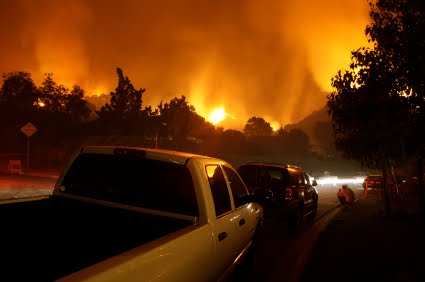
At this mid-point, we're going to take another detour, but a very closely related one. With any kind of sudden emergency, you will have two immediate actions: Evacuate or Shelter In Place. These are handled by the use of very simple checklists - one for each location you might find yourself during an emergency: Home, Work or One The Road.
Today, we'll cover developing an Evacuation Plan.
---
In February, we did a post on Shelter-In-Place (SIP). This post will explore what you should do if government officials order an evacuation, or if you decide to "bug-out" based upon your own analysis of the situation.
Because the thought process and equipment needed for an evacuation are much more extensive and critical than it is for a SIP plan - you're leaving the majority of your "stuff" behind - we'll be breaking this into two posts. [UPDATED - to three posts]
Today, we'll cover the Bug-Out-Bag (BOB) Contents and your Evacuation Checklist. Tomorrow, we'll cover Evacuation Transportation and Determining/Mapping Evacuation Destinations. [UPDATED - third post on Voluntary Activation of you Evacuation Plan]
--
As with SIP, your plan is based upon a simple, easy to use checklist. It directs your actions during a time of high stress. This checklist will ensure that the actions you need to take and the gear you need to grab are not overlooked.
Also, as with your SIP plan, you will want a kit that is a pre-packed repository of your food and other necessities. The common term for this kit is a Bug Out Bag, or BOB. It should contain, in order of importance, items to provide for your (1) Survival, (2) Post-Emergency Recovery and (3) Comfort.
BOB Contents
There is an almost religious fervor as to what should be included! No one can tell you how much of which items you need to stock to prepare for your survival. You have to determine that for yourself. You also need to consider how you will transport your food and gear in the event you end up on foot.
Here is a post by my fellow California Preppers Network contributor, William Lankes, on what can be included. Here's a very good post from the guys over at Survival Cache on the seven types of gear that should be in your BOB. You can get a very detailed list here (PDF) from the folks at Survivalist Site.
Do a Google search for "BOB contents" if you need more ideas.
You must assume your BOB will contain all of your worldly goods. I like to assume that my house has burned to the ground, everything was lost, and I have nothing other than what is in my BOB.
As I've discussed in the past, when the Oakland Hills Firestorm hit in 1991, that is EXACTLY what happened to my grandfather. The only thing left in the area were the fire bricks from his neighbor's chimney.
As with most preparedness things, your BOB design and content is VERY personalized. Some people fill one or more backpacks. Personally, our BOB consists of multiple 60-quart lidded tubs you get at Walmart (Rubbermade, etc.). They are individually numbered. We grab them in order, based upon how much time and the number of vehicles we have at home when we evacuate.
Box One provides us with food, water purification, various types of equipment and self-defense items for 4 people for 11 days. It also contains copies of our critical records, medical/first aid items and $1,000 in cash.
The food in Box One is in the form of Survival Bars and MREs. Successive boxes contain more "normal" foods, such as canned meats, dried beans, grains, rice and pasta, spices and oils, etc. Earlier boxes are filled with more densely-packed foods (high calorie, high protein), and later boxes contain more "comfort" items such as deserts, sweets, gravies and the like.
Equipment and tools to prepare the foods are added to the boxes as is appropriate. Also, the first 4 boxes each contain a rudimentary ruck sack so that the contents can be carried in the event we are forced to abandon our vehicle(s). [We originally used the ruck sacks as the BOBs, but found it much easier to identify, catalog and rotate the contents when they are in a tub].
Remember: When you're developing your own BOB, build it so that Survival, Post-Emergency Recovery, then Comfort are address, in that order.
BOB Contents
- Water filtration/purification
- Food for a minimum 1500 calories (more is better) per day, per person
- Self-defense weapons (at a very minimum, you should have a number of dedicated pepper spray canisters in your BOB - these are legal in all 50 states)
- Cash (this gives you options should events not unfold as you have planned)
- Shelter (tarps, ponchos, rope/paracord, tents, etc.). This also includes clothing appropriate to the region and season.
- Fire-making tools (disposable lighters AND matches AND fire steels AND tinder)
- Important Records
- Sanitation items
- Medical/first aid items
- Air filtration masks
- Portable radio (preferably a dynamo-powered model)
- Travel Alternatives (you may be forced to abandon your vehicle)
Obviously, you and your entire group should learn and practice these skills now, before they're needed during a stressful emergency situation.
Evacuation Checklist
This list assumes you have some sort of vehicle with which to evacuate. You should also assume you'll be forced to evacuate on foot, or be forced to abandon your vehicle before you reach your final destination.
Follow the checklist, IN ORDER of what you have deemed most important. If you can complete all of the items, that is great. But you may not have the time to do so. Your list is prioritized to first provide you with Survival, THEN Post-Emergency Recovery, THEN Comfort.
YOUR OWN LIST MUST BE CUSTOMIZED FOR YOUR LIFESTYLE.
Evacuation Checklist (in order of completion)
- Load BOB into vehicle.
- Load emergency supplies of gasoline into vehicle.
- Load Sleeping bags into vehicle.
- Determine evacuation destination and choose primary route
- Contact evacuation destination and inform them of the primary route being taken
- Post evacuation destination, primary route and destination contact information inside your home
- Load additional supplies (other than those in your BOB) as time and space allows
- Precious metals/additional cash
- Additional clothing
- Additional weapons
- Home business records, family photographs, computers, storage drives
Accept The Challenge
At some time in your life, it is very likely you'll need to evacuate your home. It could be the result of a natural disaster, an accident or terrorist incident, or a horrible event, such as a house fire.
One of the key considerations is to have a mini-plan for evacuating from your work or while you're away from home. Having a Get Home Bag (GHB) - which is really a smaller version of a BOB - can make your life much easier. The biggest difference is that its focus is strictly on Survival - you're not concentrating on Post-Emergency Recovery or Comfort.
And, as with the SIP Checklist, if your place of employment does not have an Evacuation Plan, make one for yourself. Don't become a victim simply because your company lacks foresight.
---
Please click our advertiser links. They pay us so you don't have to. A click a day is all we ask!
Copyright 2010 Bison Risk Management Associates. All rights reserved. You are encouraged to repost this information so long as it is credited to Bison Risk Management Associates. www.BisonRMA.com
Thursday, February 25, 2010
Preps: Lost Records

We're going to drill down into one of the twelve impacts: Lost Records.
---
Our lives are increasingly dependent upon data and records. Most of the time, these records are used for some sort of identification or authentication, or as proof of ownership/past payment. It is incredible how much "permission" we are required to get to live our lives.
As you look through this list of items you need for many business and government services, it will dawn on you that most people have an incredible amount of very sensitive information in their possession.
Despite the massive shift from paper-based records to electronic media, good old printed copies of records are still an effective back-up.
Will you have easy access to your records during an emergency? Here's a partial list:
Identification: Drivers license
Identification: Passport
Identification: Marriage license
Identification: Birth certificates
Identification: Death certificates
Identification: Military ID
Identification: Military Discharge
Identification: Specialized licenses - pilot, SCUBA, EMT, Paramedic, POST
Identification: Certifications - computer skills, training (firearms, first aid, etc.)
Insurance: Automobile
Insurance: Homeowners
Insurance: Flood
Insurance: Earthquake
Insurance: Renters
Insurance: Life
Insurance: Medical
Insurance: Boat
Insurance: Other (liability, umbrella policy, etc.)
Legal: Wills and trusts
Legal: Power of Attorney
Legal: Medical Directives
Legal: Business and personal contracts
Medical: Drug Prescriptions
Medical: Eyeglass Prescriptions
Medical: Personal Health Record (PHR)
Automobile: License and registration
Firearms: Sales receipt/registration information with serial number
Firearms: Concealed Carry permit
Membership Number: Civic organizations and clubs (i.e., Moose Lodge, Elk, NRA, Optimist, Rotary, etc.)
Data List: Bank account numbers and contact information.
Data List: Retirement account numbers and contact information.
Data List: User names and passwords to email accounts, blogs, business websites, bank accounts
Data List: Phone numbers and addresses of friends, family and other individuals you may need to contact
---
Looking at the contents of the list, you should realize that this package of information contains the keys to your financial, medical and personal life. If it were to fall into the wrong hands - either by theft, breach of trust, or by accident - your life would be an open book to the possessor of that information.
At a minimum, it would take a great deal of time to cancel and re-issue the compromised documents. Depending upon who had access to the information, it could cost you a great deal of time, inconvenience and money.
Generally speaking, the best place for the originals of these documents is at home, locked in a fireproof safe.
What if the safe is stolen or destroyed? During the Oakland Hills fire in 1991, it got so hot that concrete burned (let THAT image sink in). My grandfather lost his home in that fire, and the only thing left on his lot was the fireplace. Even his metal stair banister had melted.
So, you want to have at least one copy of your records off-site in a safe location (bank safe deposit box, trusted relative, trusted friend or cache).
About those trusted sources - be careful. If you're going to use them, I strongly recommend that your copied records be placed in a tamper-evident bag (such as these) so you know if the records have been viewed by others.
Another alternative is using something like a FoodSaver sealer for the records. Obviously, a nosy relative/friend could just open the bag and re-seal it (or make another one). One way to thwart this would be to write your name and the date across one of the seals, and a note such as, "Private Documents" over the other seal. Be sure to do this in your own handwriting, with an indelible pen (such as a Sharpie).
Since each of these precautions use bags that are see-thru, be sure to have a blank sheet of paper (or two, depending on how opaque the paper might be) on the top and bottom of your documents to obscure any information.
On the flip-side, if you use a public repository - such as a bank safe deposit box - your records are subject to access by government officials via a subpoena. Your lifestyle, and the trustworthiness of your family and friends will dictate the most secure off-site location for your copied records.
We keep a third copy in our version of the Bug Out Bag. We actually use 60 quart lidded tubs which are numbered in the order of how they should be grabbed in the event of an evacuation. Box number 1 has a FoodSaver sealed pack of our documents.
If we have to evacuate, we'll have our records in an easily accessible form, and won't have to go fumbling to open up the safe.
---
Another option - which is also something we use - is to scan your documents, and retain an image on a small thumb-drive data storage device. If you do this technique, you MUST be sure you encrypt the information. Otherwise, your records - in electronic form - are readily available to be distributed around the world.
I strongly recommend a FREE program called TrueCrypt. It is a encryption program that allows you to actually set up an encrypted drive on your zip drive. My thumb drive holds my records and the program, with TONS of space left over.
Yes, it's a bit technical in nature. But, it is well worth the effort to learn about this. Once you understand the concept, setting up the encrypted drive is very easy.
If need be, you can carry all of your personal information an a thumb-drive that's on a lanyard around your neck. Or perhaps you can give the thumb drive to your friend or relative. Unless they know your STRONG password, they can't access the documents.
I use TrueCrypt for this purpose, as well as encrypting a drive on my work computer. This is where I keep all of the personal sensitive information on my customers. When they provide me with their credit card information, for instance, I scan the paper where I wrote down the information, save it on my encrypted drive, then shred the paper document.
Accept The Challenge
Regardless of the route you take - either paper-based or electronic - it is crucially important for you to have back-up copies of your important documents. Be sure you tread very carefully, though.
As noted, this information is important to you, and can be valuable to a criminal. Don't make your emergency preps be the cause of an emergency in your life!
---
Please click our advertiser links. They pay us so you don't have to. A click a day is all we ask!
Copyright 2010 Bison Risk Management Associates. All rights reserved. You are encouraged to repost this information so long as it is credited to Bison Risk Management Associates. www.BisonRMA.com
Friday, February 19, 2010
Shelter In Place

At this mid-point, we're going to take a little bit of a detour, but a very closely related one. With any kind of sudden emergency, you will have two immediate actions: Evacuate or Shelter In Place. These are handled by the use of very simple checklists - one for each location you might find yourself during an emergency: Home, Work or One The Road.
Today, I'll cover Shelter In Place (SIP).
---
If an emergency occurs, you may need to independently make the decision to evacuate or SIP, or the local authorities may issue orders one way or the other. Regardless, you're going to be under stress. Having your actions pre-defined by the use of checklists can help ensure nothing, "falls between the cracks" - important actions are not missed and needed materials are not forgotten.
Generally speaking, a SIP emergency can have three broad causes - some sort of a toxin is in the air (a poisonous gas or chemical release, smoke from large fires), some sort of safety emergency has happened (civil unrest, fugitive searches) or a sudden weather-related event is occurring (tornado, etc.).
For instance, this past weekend, we had a SIP issued while authorities searched for the people responsible for a shooting near our home. Since I heard the gunfire (all 20+ shots), our SIP plan kicked into place before we received the official notice.
What SIPs have in common is that they are generally short in duration - usually measured in hours, not weeks or months. We recommend, though, that you assume it will last a couple of days, and prepare accordingly.
The SIP at Home Checklist:
All Emergencies:
- Move to your "safe room". This is a room or safe area near the center of your home, on the lowest level possible. It must have the ability to receive radio waves so you can get news reports and notification of the SIP status. Ideally, it will have two ways in and out - preferably no windows. You may need to evacuate and one exit may become impassible.
- Grab your SIP bucket (more on this later)
- Grab your Specialty Medical kit (more on this later)
- Grab your Bug Out Bag, (you may be required to evacuate at some point)
- Grab 5 gallons of water (assumes a family of 4)
- Turn off air conditioning or central forced-air heater.
- Seal doors, windows, electrical outlets and air ducts of safe room with sheets of plastic and duct tape.
- Turn on radio to news station
- Lock all doors and windows. Close all window blinds and curtains.
- If a CIVIL DISTURBANCE such as riot, turn off all lights in your home to make it appear empty - and less likely to be attacked.
- If a FUGITIVE SEARCH, such as the police pursuing a wanted criminal, turn on all internal and external lights to make it appear occupied. They are most times looking to hide, not move towards light.
- Arm all external home perimeter alarms (be sure NOT to set any interior motion detectors if you are not going to stay in your safe room).
- Load and otherwise make-ready all defensive weapons.
- Board up windows - if present - in Safe Room. All materials - plywood, fasteners, tools, etc. - should be pre-positioned in the safe room.
Note 1: Of course, if at all possible, have all of these supplies pre-positioned in your safe room.
Note 2: The lights on/off issue is a contentious one, that you must decide for yourself. During a fugitive search, would having the lights on make the criminal less likely to go towards your home, as they are trying to hide in the shadows? Or will it draw them towards your home, in hopes of taking hostages?
Note 3: There is also some contention regarding entering your safe room during a riot. Some contend that your home may be ransacked or burned to the ground around you. These are both certainly possible.
Historically, riots have occurred in the commercial districts of cities. Think about the 1992 LA riots or the more recent riots in Oakland surrounding the BART police officer shooting a passenger. Businesses were destroyed, not homes. Residential neighborhoods are generally along the route to the riot, and don't take the damage that commercial areas take.
Both items - lighting and your location in your home during a riot - are personal decisions YOU must make. What we're pushing for is that you consider the options and make your plans NOW, not during the stressful emergency.
Note 4: The average person inhales and exhales 14 times a minute. The average volume per breath is 0.5 liters. A 12x12 room with 8 foot ceilings has 32,621 cubic liters of air (12 x 12 x 8 x 28.317). This is theoretically enough air for 4 people for 19 hours. In practice, of course, this is not true, as the exhaled air is primarily CO2, which would begin displacing the air in the room, and eventually kill the inhabitants.
My personal rule-of-thumb would be to not remain in the room for more than 4 or 5 hours without an air exchange. You need to make your own calculations and "trip-wires" for when you would evacuate the room.
Addendum - Note 5: Obviously, if you have sealed your safe room against outside air, DO NOT light any flames for cooking, warmth or relaxation (cigarettes or pipes). Aside from the fire danger, you will rapidly consume the available air, while simultaneiously filling the room with whatever exhaust is coming from the combustion.
---
SIP Bucket Contents
| What | Why |
| 1 - 6 gallon lidded bucket | To hold all SIP supplies and to act as your emergency toilet |
| 5- Emergency "space" blankets | 4 are for use as blankets for warmth, and one is to be hung in a corner to provide privacy for the make-shift toilet |
| 1- bag pine bedding shavings | For the toilet between uses |
| 4- 3600 calorie survival bars | To be eaten if hungry |
| 4- packs of moistened baby wipes | Toilet use and general hygiene |
| 2-100 ft rolls of duct tape | For securing plastic sheeting and privacy blanket |
| 2- BLACK plastic sheets | To secure around doors, windows and air ducts of safe room. Black to keep light from "leaking" outside |
| 1- Dynamo powered radio | To keep abreast of developments. Dynamo powered so you don't need to rely on batteries |
| 1- Dynamo or shakable flashlight | For light. Dynamo or shakable powered so you don't need to rely on batteries |
| 1- Standard first aid kit | First aid |
| 1- Pair of scissors | To cut duct tape and black sheets for air ducts |
| 3- 33 gallon trash bags | Besides holding trash, too many uses to list |
| Playing cards, toys, games | Entertainment during SIP - especially important if you have children |
| Self-defense weapon | Including ammunition if it is a firearm. Ensure safe storage guidelines are followed, especially if children are present in your home |
Other optional items:
- If you live very near a chemical plant, power plant, industrial/manufacturing facility or a rail line, consider adding gas masks to your kit.
- If women/girls of reproductive age are in your group, include feminine hygiene items in your kit.
- If you have babies in your group, add formula, bottles and disposable diapers to your kit.
Specialty Medical Kits
As with any preparedness issue, your list must be customized to your lifestyle. You or your family members may have special medical needs - diabetes supplies, colostomy bags, anxiety medications, wheel chairs, asthma inhalers - be sure to include them in your kits.
For diabetics, your All Emergency portion of the list might include grabbing an ice chest, filling it with ice, and grabbing your insulin supplies.
If you have home dialysis equipment, consider housing it in your safe room and doing your treatments there.
Accept The Challenge
Take this list and customize it for your own circumstances. Do this now, while you are able to think and act clearly. Be sure all of your family members know where the list is located, and where the various buckets and kits are located.
Also take the time to develop similar lists for Work and One The Road. You never know where you'll be when an emergency occurs.
For work, your SIP kit and plans may be very rudimentary. If your employer does not have a plan, YOU should consider what you would do in an emergency situation. Is there a safe, secure area you could move to? A restroom, supply closet or somewhere similar? Don't allow yourself to become a victim simply because your employer has not developed a plan.
While On The Road, incorporate as much equipment as you can into your Get Home Bag. Many of the items are dual purpose.
---
Please click our advertiser links. They pay us so you don't have to!
Copyright 2009 Bison Risk Management Associates. All rights reserved. You are encouraged to repost this information so long as it is credited to Bison Risk Management Associates. www.BisonRMA.com
Subscribe to:
Posts (Atom)